Aluminum MIG Wire: How to Choose Between 4043 and 5356
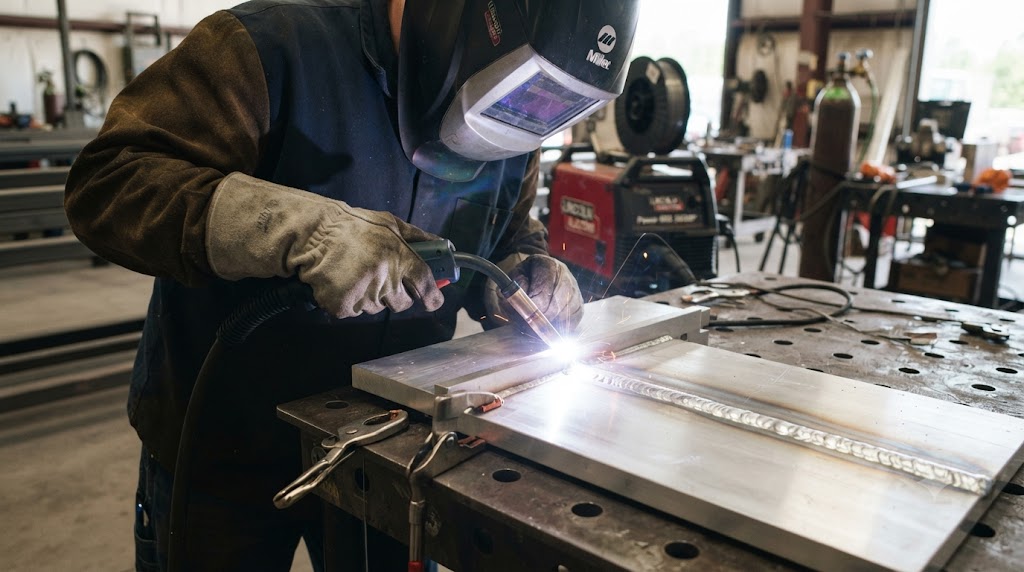
Aluminum humbles MIG welders who breeze through steel. The wire is soft enough to birdnest at the drive rolls, the metal sucks heat away and then suddenly collapses into a puddle, and picking the wrong filler alloy leaves you with cracks or a color mismatch you cannot buff out. Half the battle is won or lost before the arc strikes, in the choice between the two aluminum wires that cover almost everything: 4043 and 5356.
Aluminum MIG wire comes mainly in two alloys, ER4043 and ER5356, and choosing between them depends on the base aluminum and whether you need strength, crack resistance, or anodizing color match. Both run on 100 percent argon with DC electrode positive and feed best with a spool gun. Here is how to choose and weld with each.
The two alloys that cover most work
Nearly all aluminum MIG welding uses one of two filler wires:
- ER4043 is a silicon-based alloy (around 5 percent silicon). It flows smoothly, resists cracking, and produces clean welds, making it the general-purpose choice, especially for 6xxx-series aluminum and castings.
- ER5356 is a magnesium-based alloy (around 5 percent magnesium). It is stronger, better for marine and 5xxx-series aluminum, and matches anodizing color better, but it is stiffer and can be harder to feed.
Think of ER4043 as the smooth, forgiving general-purpose wire and ER5356 as the stronger, feed-stiffer specialist. Between them they handle the large majority of aluminum jobs.
Direct answer: 4043 or 5356?
Match the wire to your base metal and goal:
- Choose ER4043 for 6xxx-series aluminum, castings, and general-purpose work where you want smooth flow, easy feeding, and crack resistance. It is the more forgiving wire to weld.
- Choose ER5356 for 5xxx-series aluminum, marine and saltwater applications, parts that need higher strength, or anything you will anodize and want the color to match.
When in doubt on common 6061 general fabrication, ER4043 is the easier, more forgiving choice. When the part is structural, marine, or will be anodized, ER5356 is worth the stiffer feed.
Strength, cracking, and color: the trade-offs
The choice usually comes down to three factors:
- Strength: ER5356 is stronger than ER4043, which matters for load-bearing and structural aluminum.
- Crack resistance and flow: ER4043 flows more smoothly and resists cracking better on crack-sensitive alloys and castings, making it more forgiving.
- Anodizing color: if the part will be anodized, ER5356 blends far better, while ER4043 can turn dark or gray and stand out.
- Feedability: ER4043 is softer and feeds more easily, while ER5356 is stiffer and more prone to feeding trouble, which favors a spool gun.
Weigh strength and anodizing (favoring 5356) against smooth feeding and crack resistance (favoring 4043) for your specific part.
The feeding challenge
Aluminum wire is soft, which creates the single biggest frustration in aluminum MIG: feeding. Soft wire kinks and birdnests at the drive rolls if pushed through a long standard gun liner. The fixes:
- Use a spool gun, which holds a small spool right at the gun so the wire only travels a few inches, the most reliable way to feed aluminum. A push-pull gun is the alternative for longer reach.
- Use U-groove drive rolls designed for soft wire, not V-groove rolls that dig in.
- Use a nylon or Teflon liner to reduce friction, and keep drive roll tension light.
- Run 100 percent argon shielding gas on DC electrode positive (DCEP), and expect to weld hotter and faster than steel because aluminum pulls heat away quickly.
Which aluminum MIG wire to buy
Here are dependable ER4043 options, the more forgiving starting point for most.
- ER4043 aluminum MIG wire (.035 inch, 5 lb spool) is a smooth-flowing general-purpose wire for 6xxx-series aluminum and castings in the common .035 inch size, a forgiving choice for learning aluminum. Its limitation is lower strength than 5356 and poorer anodizing color match.
- ER4043 aluminum MIG wire (3/64 inch, 16 lb spool) suits heavier aluminum work and longer runs, in the thicker 3/64 inch size on a large spool for production. The trade-off is that 3/64 inch is meant for thicker material and higher amperage, not thin sheet.
For ER5356, choose a magnesium-based aluminum wire in your needed diameter when the part is structural, marine, or will be anodized; feed it with a spool gun for best results, since 5356 is stiffer than 4043.
How to choose: for general 6061 fabrication and castings, start with ER4043 for its forgiving flow and feeding. Move to ER5356 when you need higher strength, marine corrosion performance, or an anodizing color match, and use a spool gun to handle its stiffer feed.
Who should skip ER5356: someone welding crack-sensitive castings or general 6xxx parts that will not be anodized, where ER4043’s smoother flow and crack resistance serve better.
The bottom line
Aluminum MIG comes down to two wires: ER4043, the smooth, forgiving, crack-resistant general-purpose choice for 6xxx aluminum and castings, and ER5356, the stronger, anodize-friendly choice for 5xxx and marine work that feeds stiffer. Run either on 100 percent argon with DC electrode positive, and solve the feeding challenge with a spool gun, U-groove rolls, and a smooth liner. Match the alloy to your part, tame the feed, and aluminum stops being intimidating.
FAQ
What is the difference between ER4043 and ER5356 aluminum wire? ER4043 is a silicon-based alloy that flows smoothly, resists cracking, and feeds easily, ideal for 6xxx aluminum and castings. ER5356 is a magnesium-based alloy that is stronger, better for marine and 5xxx aluminum, and matches anodizing color, but it feeds stiffer.
Which aluminum wire should a beginner use? ER4043 is generally more forgiving because it flows smoothly, resists cracking, and feeds more easily than the stiffer ER5356. It is a good starting point for general 6061 fabrication and castings.
What gas do you use for aluminum MIG welding? 100 percent argon, run on DC electrode positive (DCEP). Aluminum pulls heat away quickly, so you generally weld hotter and faster than you would on steel of the same thickness.
Why does aluminum wire keep birdnesting? Aluminum wire is soft and kinks when pushed through a long standard gun liner. Use a spool gun (or push-pull gun), U-groove drive rolls, a nylon or Teflon liner, and light roll tension to feed it reliably.
Which aluminum wire is best for anodizing? ER5356 matches anodizing color far better, while ER4043 can turn dark or gray and stand out. Choose ER5356 for parts that will be anodized.
Do I need a spool gun for aluminum? A spool gun is strongly recommended because it feeds the soft aluminum wire only a few inches, avoiding birdnesting. A push-pull gun is the alternative for longer reach; a standard gun often struggles with aluminum.
References
- Lincoln Electric and Hobart Brothers aluminum filler metal selection guides, including ER4043 versus ER5356 (manufacturers).
- American Welding Society AWS A5.10 aluminum and aluminum-alloy welding electrodes and rods classification, aws.org.
- Miller Electric aluminum MIG welding, spool gun, and shielding gas guidance (manufacturer), millerwelds.com.