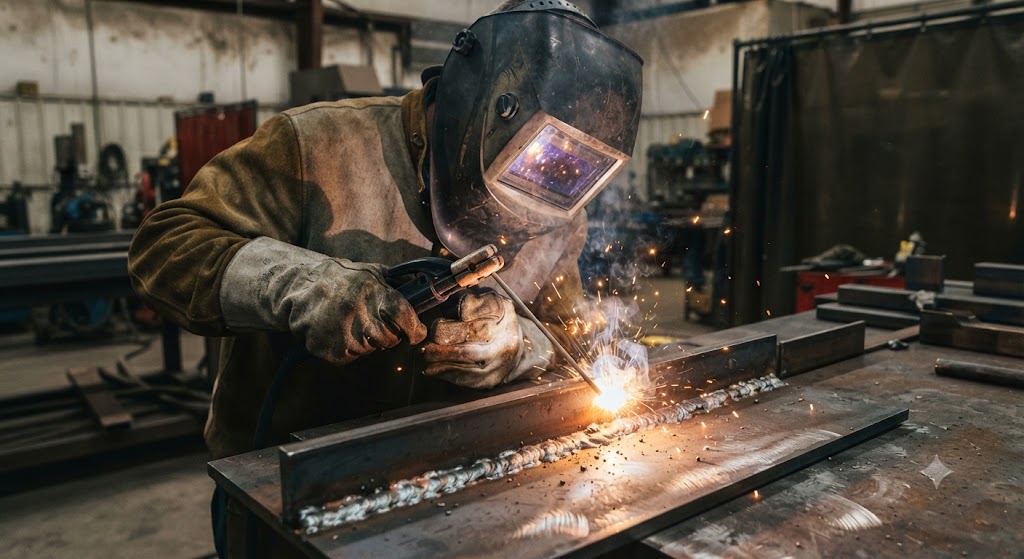
Flux Welding Wire: Classification, Setup and Best Uses
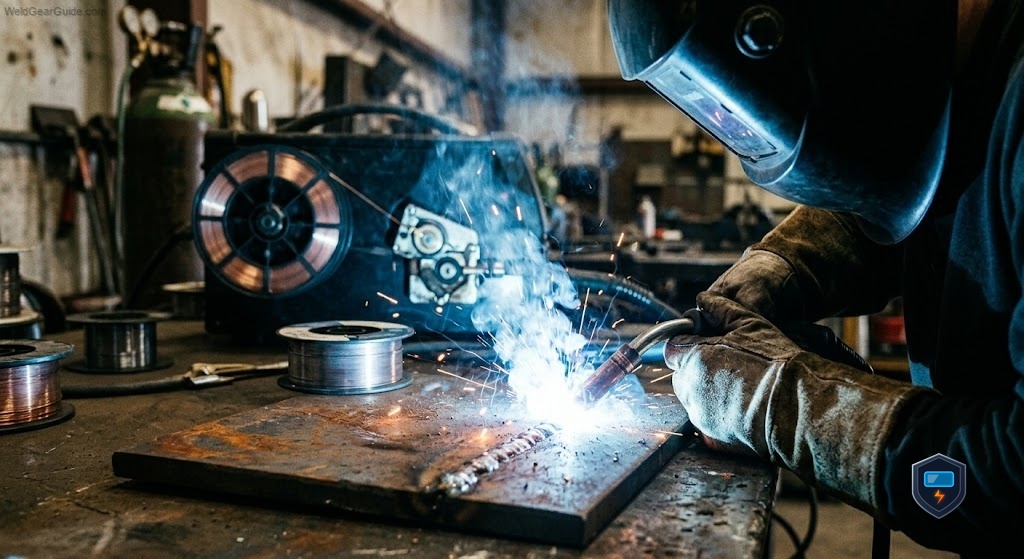
You set up your MIG welder in the driveway to fix a gate hinge. The wind is barely 5 miles per hour, but it is enough to blow your argon-CO2 cloud away from the puddle. Your welds come out gray and porous, full of pinholes you can see without a magnifier. You grind them out and try again. Same result. The gas is not the problem. The wind is.
This is the moment most people discover flux welding wire. Flux-cored wire, properly called Flux-Cored Arc Welding or FCAW, builds the shielding into the wire itself. The wire is a hollow tube filled with flux compounds that burn and generate their own shielding gas at the arc. No bottle, no regulator, no gas to blow away. You can weld in a driveway, a field, or a barn doorway, and the welds will be sound.
Flux welding wire is a tubular electrode with fluxing agents inside the core. It comes in two types: self-shielded (FCAW-S), which needs no external gas, and gas-shielded (FCAW-G), which uses external gas plus the internal flux for double shielding. For most garage and field work, self-shielded is what you want.
The short answer: for general-purpose outdoor welding on mild steel, use E71T-11 self-shielded flux-cored wire in 0.030 or 0.035 diameter. Set your machine to DC electrode negative. Run 0.030 for sheet metal and thin stock, 0.035 for material 1/8 inch and thicker. Remove the slag after every pass with a chipping hammer and wire brush.
E71T-11 vs E71T-GS: Two Different Wires
Both are self-shielded flux-cored wires, and both are classified under AWS A5.20 (not A5.18, which covers solid wire). But they are not the same thing.
E71T-11 is the most common self-shielded flux-cored wire for general fabrication. It is rated for all-position welding and limited multi-pass work. The wire produces its own shielding gas from the flux core, runs on DCEN, and does not require an external gas bottle. According to Hobart Brothers, E71T-11 wires are easy to use with a wide parameter window that forgives technique errors, which makes them popular with newer welders. The catch: E71T-11 wires do not have required impact toughness properties, so they are not rated for critical structural applications. AWS D1.1 allows them for materials under 1/2 inch thick, which covers most garage and farm work.
E71T-GS is a general specification that covers single-pass self-shielded wire. It is designed for thin-gauge steel (22 gauge to 3/16 inch) and is not rated for multi-pass welding. If you are welding sheet metal or light tubing and only need single-pass welds, E71T-GS works. If you need to build up multiple passes on thicker material, you need E71T-11.
The practical difference: E71T-11 is your all-around wire. E71T-GS is for thin stock only. If you buy one spool, make it E71T-11.
Polarity: Opposite of Solid Wire
This is where people get burned. Solid wire runs on DCEP (gun positive). Self-shielded flux-cored wire runs on DCEN (gun negative). If you swap from solid wire to flux-cored and forget to switch the polarity, your welds will look terrible: excessive spatter, poor penetration, and a ragged arc.
On most machines, switching polarity means physically swapping the cable connections at the front panel or inside the wire feeder compartment. Some newer machines have a switch. Check your manual. This is the single most common setup error with flux-cored wire, and it takes 30 seconds to fix once you know to look for it.
Wire Diameter: 0.030 vs 0.035
The two common sizes for self-shielded flux-cored wire are 0.030 and 0.035 inch. The choice matters less than people think, but each has its place.
0.030 flux-cored wire runs at 80 to 150 amps and is better for thinner material (18 gauge to 3/16 inch). It produces less spatter and is easier to control on sheet metal. If you are welding auto body panels, thin tubing, or light fencing, 0.030 is the right pick.
0.035 flux-cored wire runs at 120 to 200+ amps and penetrates deeper on thicker stock (1/8 inch and up). It deposits more metal per second, which means fewer passes on thick material. The trade-off is more spatter and a rougher bead on thin material. If you are welding 1/8 inch or thicker and your machine has the amperage to support it, 0.035 is the better choice.
If you have a 90-amp flux wire welder, like the Chicago Electric 90 amp sold at Harbor Freight, you are limited to 0.030 wire. The machine does not have the amperage to run 0.035 cleanly. With 0.030 flux-cored wire at 80 to 90 amps, you can weld 18 gauge to 3/16 inch mild steel in a single pass. The Chicago Electric 90 amp is a real tool for light repair work, but its wire feed consistency is its weak point. Even with correct tension settings, the feed tends to skip, which limits you to short beads and stitch welds. If you need to lay long continuous beads, this machine will frustrate you.
Self-Shielded vs Gas-Shielded Flux-Cored Wire
Self-shielded (FCAW-S) wire generates its own shielding from the flux core. No external gas needed. This is what you use outdoors, in wind, or when you do not want to deal with a gas bottle. It produces slag that must be chipped off after welding.
Gas-shielded (FCAW-G) wire, classified as E71T-1, uses external shielding gas (usually 75/25 argon-CO2 or 100 percent CO2) in addition to the flux core. It produces a smoother bead, less spatter, and better appearance than self-shielded wire. The slag is easier to remove. But it requires a gas setup, so it defeats the main reason most people buy flux-cored wire in the first place.
If you already have a gas setup and want the benefits of flux-cored wire (higher deposition rate, better penetration on thick material), gas-shielded E71T-1 is worth considering. If you are buying flux-cored wire specifically to avoid gas, stick with self-shielded E71T-11.
Setting Up Your Machine for Flux-Cored Wire
Four things change when you switch from solid wire to flux-cored:
- Polarity: switch to DCEN (gun negative, ground positive).
- Drive rolls: use knurled drive rolls, not smooth ones. Flux-cored wire is softer and can be crushed by smooth V-groove rolls. Knurled rolls grip the wire without deforming it.
- Contact tip: use the same size as the wire diameter. Flux-cored wire can be slightly irregular in diameter, so some welders go one size larger on the contact tip to prevent binding.
- Gas: turn off the gas flow if you are running self-shielded wire. The wire does not need it, and running gas while flux-cored welding is a waste.
After each pass, chip the slag with a chipping hammer and brush the weld with a wire brush. Slag inclusion is the most common defect in flux-cored welds, and it happens when you try to weld over slag from the previous pass without removing it first.
Three Flux-Cored Wires Worth Buying
Lincoln Electric Innershield NR-211-MP is an E71T-11 self-shielded flux-cored wire in 0.035 diameter. It is classified for all-position welding on light gauge to thin plate, with a recommended maximum plate thickness of 1/2 inch. The wire runs smoothly, produces a stable arc, and the slag lifts cleanly for easy removal. The flaw: at 0.035 diameter, it is too much wire for thin sheet metal. On 18 gauge and thinner, it will blow through unless you keep your travel speed fast and your amperage low. Who should skip this: if you are welding mostly thin material, buy the 0.030 diameter version or choose an E71T-GS wire instead.
Hobart H222106-R22 E71T-11 in 0.030 diameter is a 10-pound spool of self-shielded flux-cored wire. It produces porosity-free, X-ray quality welds with easy slag removal, and runs on DCEN without external gas. The flaw: the wire is more sensitive to drive roll tension than solid wire, and overtightening the tension will flatten the tube and cause feeding problems. Who should skip this: if your machine has marginal wire feed power (like some 90-amp entry-level units), the stiffer flux-cored wire may feed inconsistently compared to solid wire.
Hobart H222108-R22 E71T-11 in 0.035 is the same wire in a larger diameter for thicker material. Same E71T-11 classification, same self-shielded operation, but with the deposition rate and penetration for 1/8 inch and thicker steel. The flaw: produces noticeably more spatter than the 0.030 version, which means more post-weld cleanup with a chipping hammer and wire brush. Who should skip this: if you are welding mixed thicknesses and only want one spool, 0.030 is more versatile.
The Real Question: Do You Even Need Flux-Cored Wire?
If you weld indoors on clean material, solid wire with 75/25 gas will give you a cleaner weld with less cleanup. Flux-cored wire earns its place when you weld outdoors, on dirty or rusty material, or when you do not want to invest in a gas setup. It penetrates deeper than solid wire at the same amperage and handles surface contamination better.
The trade-off is slag removal and spatter. Every flux-cored weld requires chipping and brushing before the next pass. If you are doing single-pass repair welds on a gate or a fence panel, that is 10 seconds of cleanup. If you are doing multi-pass welds on a structural joint, it adds up.
Frequently Asked Questions
Do you need shielding gas with flux welding wire?
Self-shielded flux-cored wire (E71T-11, E71T-GS) does not require external shielding gas. The flux core generates its own shielding. Gas-shielded flux-cored wire (E71T-1) does require external gas, usually 75/25 argon-CO2 or 100 percent CO2.
What polarity does flux-cored wire use?
Self-shielded flux-cored wire uses DC electrode negative (DCEN), which is the opposite of solid wire. The gun connects to the negative terminal and the ground clamp to positive. Gas-shielded flux-cored wire (E71T-1) uses DCEP, same as solid wire.
What is the difference between 0.030 and 0.035 flux-cored wire?
0.030 wire runs at 80 to 150 amps and is better for thin material (18 gauge to 3/16 inch). 0.035 wire runs at 120 to 200+ amps and penetrates deeper on thicker stock (1/8 inch and up). For a 90-amp machine, 0.030 is the only practical choice.
Can you weld multiple passes with E71T-11 wire?
Yes, but only in limited amounts. E71T-11 is rated for limited multi-pass welding. For heavy multi-pass work on thick material, a gas-shielded flux-cored wire like E71T-1 is a better choice because it has better toughness properties and cleaner slag removal between passes.
Can you use flux-cored wire in a regular MIG welder?
Yes, as long as you switch the polarity to DCEN and use knurled drive rolls. Most MIG welders can run self-shielded flux-cored wire. Check that your machine accepts the spool size and has the correct drive roll type.
What is E71T-GS wire used for?
E71T-GS is a general specification for single-pass, self-shielded flux-cored wire designed for thin-gauge steel (22 gauge to 3/16 inch). It is not rated for multi-pass welding. Use it for sheet metal work and light repairs where you only need a single pass.
Why do my flux-cored welds have pinholes?
Pinholes (porosity) in flux-cored welds are usually caused by moisture in the wire, dirty base metal, or incorrect polarity. Check that you are running DCEN, clean the metal to bare steel, and store your wire in a sealed container with desiccant when not in use.
Is flux-cored wire better than solid wire?
Neither is universally better. Flux-cored wire is better for outdoor welding, dirty material, and deeper penetration. Solid wire with gas is better for indoor work, thin material, and clean appearance with less spatter. Most welders keep both on hand.