Gas for a Wire Welder: What to Run and Why It Matters
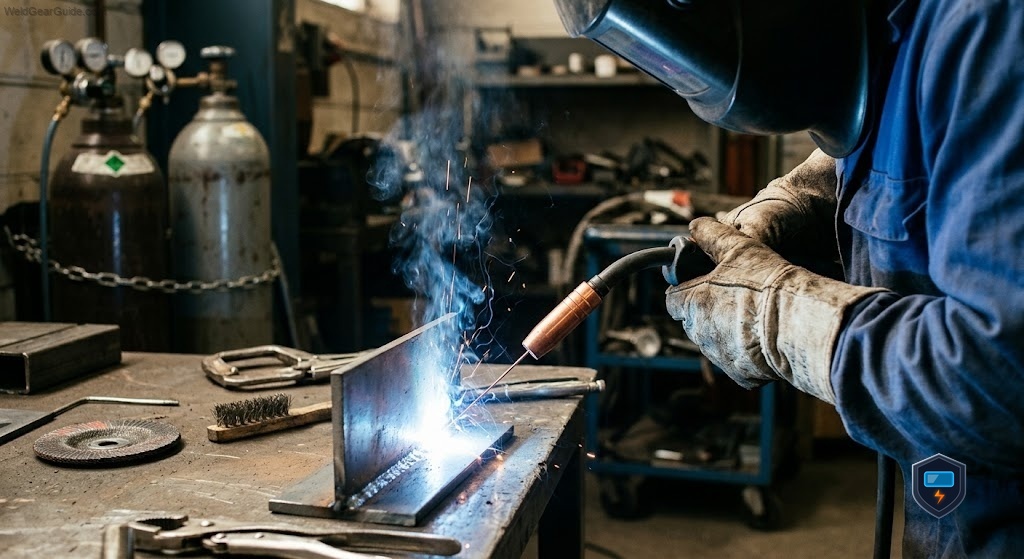
You can dial in your wire feed speed, set your voltage dead on, and still lay down a weld that looks like it has measles. Pinholes scattered across the bead, porous and weak, because the shielding gas was wrong or the flow rate was off. The gas is not an accessory on a wire welder. It is the process.
Gas for a wire welder refers to the shielding gas used in the MIG (Metal Inert Gas) or GMAW (Gas Metal Arc Welding) process. The gas flows through the gun nozzle and surrounds the weld pool, displacing atmospheric oxygen and nitrogen that would otherwise contaminate the molten metal. Without it, or with the wrong mix, you get porosity, brittle welds, and excessive spatter.
For welding mild steel with solid wire, the two realistic gas choices are a 75 percent argon and 25 percent CO2 mix (called C25 or 75/25) and 100 percent CO2. The 75/25 mix is the industry standard for most shop and hobby work. Straight CO2 has its place, but the bead appearance and spatter levels are noticeably worse.
75/25 Argon-CO2: The Default for a Reason
A 75/25 argon-CO2 mix gives you the best balance of penetration, bead appearance, and spatter control for mild steel. The argon stabilizes the arc and produces a smoother transfer, while the CO2 adds penetration and heat. The result is a weld that lays down flat with minimal cleanup.
The 75/25 mix works in short-circuit transfer mode, which is what most hobby and light fabrication welders run. It produces a stable arc at lower voltages, makes the puddle easy to control, and generates far less spatter than straight CO2. For sheet metal, auto body work, and general fabrication, it is the right gas. Miller Welding recommends 75/25 as the standard for DIY MIG applications on mild steel.
The flaw: 75/25 is more expensive than straight CO2. You are paying for the argon content and the mixing. For a high-volume shop running wire all day, the difference adds up. For a hobbyist going through one or two bottles a year, it is negligible.
Who should skip 75/25: nobody, for mild steel. If you are welding mild steel with solid wire, this is your gas. The only reason to switch is if you are welding aluminum (100 percent argon), stainless (trimix or 98/2 argon-CO2), or you are doing high-deposition work where straight CO2 makes economic sense.
100 Percent CO2: Deeper Penetration, More Cleanup
Straight CO2 is the working-class alternative. It runs roughly a third of what 75/25 runs per cubic foot, penetrates deeper thanks to the hotter arc, and works fine for thicker material where appearance is secondary.
The trade-offs are real. CO2 produces more spatter than 75/25, the bead is rougher and more convex, and the arc is harder to tune. You will spend more time chipping spatter and grinding the bead. For structural welds on thick material where the weld will be ground flat anyway, this does not matter. For visible welds on thin material, it does.
CO2 also requires different voltage settings than 75/25. For the same wire feed speed, CO2 needs more voltage to maintain a stable arc. If you switch from 75/25 to CO2 without adjusting your machine, the arc will be unstable and the weld quality will drop.
Who should skip CO2: anyone welding sheet metal, auto body panels, or anything thinner than 3/16 inch where bead appearance matters. The spatter and rough bead are not worth the savings on those jobs.
Matching Gas to Your Wire
The most common solid MIG wire for mild steel is ER70S-6, meeting AWS A5.18. The “6” in ER70S-6 indicates higher levels of silicon and manganese deoxidizers, which clean impurities from the weld pool and make the wire tolerant of mild rust and mill scale on the base metal. ER70S-6 works with both 75/25 and 100 percent CO2.
ER70S-3 has lower silicon and manganese content. It produces a cleaner weld on new, clean steel but does not handle rust and mill scale as well as ER70S-6. If you are welding new hot-rolled plate with light mill scale, ER70S-3 with 75/25 gas gives a flatter, cleaner bead. On anything with surface contamination, step up to ER70S-6.
ER70S-2 is the triple-deoxidized wire, with aluminum, titanium, and zirconium added alongside silicon and manganese. It is designed for welding on rusty, dirty, or unknown steel where you cannot clean the surface. Most hobbyists and small shops will never need it. ER70S-6 handles moderate contamination well enough for 90 percent of real-world work. ESAB’s wire selection guide breaks down the chemistry differences in detail.
For stainless steel, the wire changes to ER308L (for 304 stainless) or ER316L (for 316 stainless), meeting AWS A5.9. The gas also changes. You cannot run stainless wire with 75/25 because the CO2 will add carbon to the weld and cause sensitization. Use a high-argon mix like 98 percent argon and 2 percent CO2 (often called C2) for short-circuit transfer on stainless.
For aluminum, the wire is ER4043 or ER5356 and the gas is 100 percent argon. No CO2, no mix. CO2 will not work with aluminum.
Wire Diameter and Gas Flow
The most common wire diameters for hobby and light fabrication are 0.030 inch and 0.035 inch. Thinner wire (0.023 or 0.024 inch) is for sheet metal and auto body work. Thicker wire (0.045 inch) is for heavier fabrication.
Gas flow rate matters as much as the gas mix. Too little flow and the weld pool is not shielded, causing porosity. Too much flow and you create turbulence that pulls atmospheric air into the shield, which also causes porosity. The sweet spot for indoor welding is 20 to 25 CFH (cubic feet per hour). Outdoors or in drafty conditions, you may need 30 to 35 CFH, but if the wind is strong enough to need more than that, you should be welding inside or using flux-cored wire instead.
The Hobart H305406-R22 ER70S-6 in 0.030 inch on a 10-pound spool is the wire I would point most people toward for general mild steel work with 75/25 gas. It feeds smoothly, the deoxidizer package handles typical shop conditions, and the bead lays flat with minimal post-weld cleanup. The AWS classification is A5.18 ER70S-6, and it is rated for use with both 75/25 and 100 percent CO2.
The flaw: the copper coating on Hobart wire can build up on your contact tip over time, causing erratic wire feeding. Clean or replace your contact tip more often if you notice feeding issues. The 0.030 diameter is versatile but will not deposit enough metal for thick plate. For material thicker than 1/4 inch, step up to 0.035 wire like the Hobart 11-pound ER70S-6 spool.
Who should skip this: if you are welding exclusively on clean, new steel sheet, ER70S-3 wire will give you a slightly cleaner bead. For everyone else, ER70S-6 is the better general-purpose choice.
Setup Mistakes That Waste Gas and Ruin Welds
Running too much flow. Cranking the regulator to 40 CFH does not give you better shielding. It creates turbulence that pulls air into the gas column and causes the exact porosity you are trying to prevent. Set 20 to 25 CFH indoors and check it with the regulator, not by feel.
Gas hose leaks. A leak anywhere between the regulator and the gun wastes gas and reduces the actual flow at the nozzle. Spray a soap solution on the fittings and hoses. If you see bubbles, you have a leak.
Wrong nozzle size. A nozzle that is too small for the gas flow will not distribute the shield evenly. Most MIG guns come with a 1/2 inch nozzle, which works for 75/25 at standard flow rates. If you switch to 100 percent CO2, you may need a slightly larger nozzle for proper coverage.
Welding in wind. Even a 5 mph breeze will blow your shielding gas away from the weld pool. If you must weld outdoors, build a wind screen or switch to flux-cored wire (like E71T-1), which does not require external shielding gas.
Making the Right Gas Call
For 90 percent of mild steel welding, 75/25 argon-CO2 with ER70S-6 wire is the answer. It gives you the best bead, the least spatter, and the widest operating window. Save straight CO2 for thick material where appearance does not matter and you want deeper penetration for less money. Match your wire to your metal: ER70S-6 for general work, ER70S-3 for clean sheet, ER308L for 304 stainless with a 98/2 gas, and ER4043 or ER5356 with 100 percent argon for aluminum. Set your flow to 25 CFH, check for leaks, and do not weld in the wind.
Frequently Asked Questions
What gas do I use for MIG welding mild steel?
A 75 percent argon and 25 percent CO2 mix (C25) is the standard shielding gas for MIG welding mild steel with solid wire. It provides good arc stability, low spatter, and a clean bead.
Can I use 100 percent argon for MIG welding steel?
No. Pure argon does not provide enough penetration for mild steel in the MIG process. It is used for TIG welding and for MIG welding aluminum, but for mild steel you need CO2 in the mix.
What is the difference between 75/25 and 100 percent CO2 for MIG welding?
75/25 produces a smoother bead, less spatter, and easier arc tuning. 100 percent CO2 penetrates deeper and is less expensive but produces more spatter and a rougher bead that requires more cleanup.
What wire goes with what gas for MIG welding?
ER70S-6 mild steel wire works with both 75/25 and 100 percent CO2. ER308L stainless wire requires a 98/2 argon-CO2 mix. ER4043 or ER5356 aluminum wire requires 100 percent argon.
What flow rate should I set my MIG gas to?
Set 20 to 25 CFH for indoor welding. Increase to 30 to 35 CFH in drafty conditions. Anything higher creates turbulence that pulls air into the shield and causes porosity.
What is ER70S-6 wire best for?
ER70S-6 is a general-purpose mild steel MIG wire with high silicon and manganese deoxidizers. It handles mild rust, mill scale, and dirty steel better than ER70S-3, making it the best choice for most shop and field work.
Can I MIG weld without shielding gas?
Only with flux-cored wire (like E71T-1 or E71T-11), which generates its own shielding from the flux inside the wire. Solid wire always requires external shielding gas.
What gas do I use for stainless steel MIG welding?
Use a 98 percent argon and 2 percent CO2 mix (C2) for short-circuit transfer on stainless steel with ER308L or ER316L wire. Do not use 75/25, as the higher CO2 content will add carbon and cause carbide precipitation.