Harbor Freight Wire Feed Welder: Setup and Limits
There is a specific moment that happens in a lot of garages. Someone buys the cheap flux welder, runs a bead on a piece of scrap angle iron, chips the slag off, and finds something that looks nothing like the welds on the internet. The instinct is to blame the machine. Nine times out of ten the machine is the least of the problem.
A Harbor Freight wire feed welder is not a pretend tool. It is a real, limited tool, and almost everything people hate about them comes from asking them to do work outside those limits, or from setup nobody explained.
What a Harbor Freight wire feed welder is
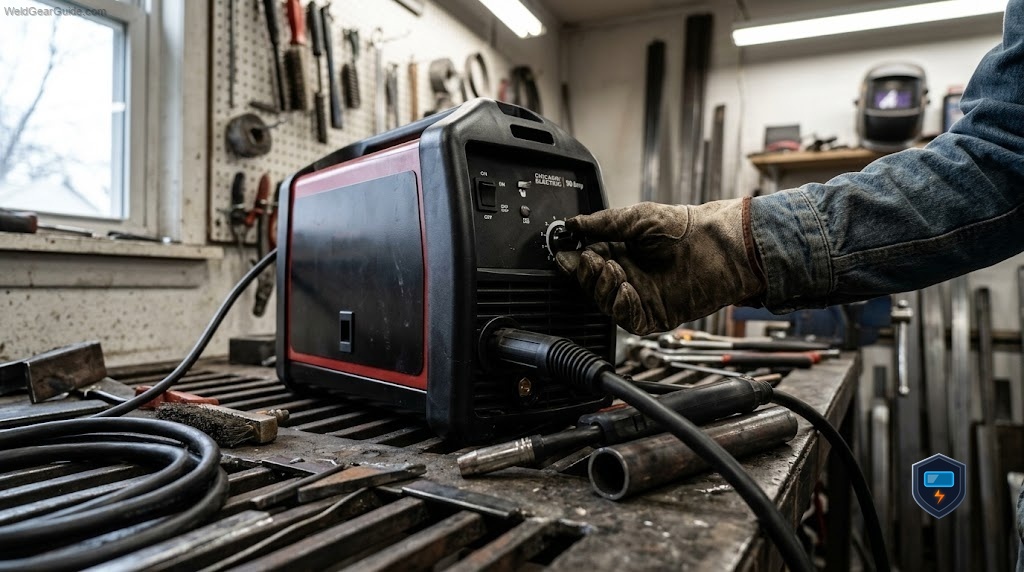
A wire feed welder pushes a continuous spool of filler wire through a gun into the arc, so you weld with a trigger rather than by feeding a rod with your off hand. Harbor Freight’s wire feed lineup runs from the Chicago Electric Flux 125, a transformer machine, up through the Titanium Easy-Flux 125 and the Titanium Unlimited 200 multiprocess unit.
The short answer to the question people are really asking: yes, these machines lay real, structurally sound welds on thin to medium mild steel, and no, none of the 125-amp units will handle heavy plate, aluminum, or any job where appearance is the point.
Where the 125-amp machines actually land
Harbor Freight’s own manual for the Flux 125 states the specification plainly: 0.030 to 0.035 flux-core wire, mild and low alloy steel, 18 gauge to 3/16 inch plate, and explicitly not for aluminum or stainless. Its duty cycle is 90 amps at 20 percent on 120V.
The Titanium Easy-Flux 125 is the same output on paper and a different machine underneath. It is an inverter rather than a transformer, weighs about fifteen pounds instead of forty-plus, runs 30 to 125 amps with a 30 percent duty cycle at 90 amps, feeds .030 and .035 wire at 60 to 200 inches per minute, and gives you continuously variable control rather than fixed voltage taps.
That difference in control is not a marketing detail. On a tapped machine you are choosing between settings that are close to right. On a continuously variable machine you can actually dial in the sweet spot, and on thin sheet that is the difference between a weld and a hole.
The 3/16 inch question
People ask constantly whether a 125-amp flux machine will weld quarter-inch or 3/8 inch steel. The manufacturer says 3/16 inch. That is a single-pass rating, and it is honest.
Can you get metal to stick together thicker than that? Yes, with beveled joints, preheat, and multiple passes. Should you, on anything that carries load, holds a trailer together, or sits over your head? No. Penetration on a 90-amp arc into cold 3/8 inch plate is shallow, and a bead that looks fine on the surface can be sitting on top of the joint rather than fused into it. That is the exact failure mode that makes cheap welders look dangerous when the real problem was the job.
Use the machine within its rating and it is genuinely reliable. Push past it and you are building something that looks welded.
Setup that fixes most complaints
Polarity. Flux-cored wire runs electrode negative. The machine ships that way, but people who convert to gas MIG and back forget to swap the leads, and then get a spattery, wandering arc they blame on the welder.
Spool direction. The Harbor Freight manual is specific about this: set the spool so the wire unwinds counterclockwise. It sounds trivial. Get it backwards and the wire fights the drive roll on every inch.
Wire size. Run .030 unless you are consistently at the top of the thickness range. Smaller wire feeds more smoothly through a small drive and gives you finer heat control on thin material.
Stickout. Flux-cored wire wants a longer stickout than solid wire, roughly three-quarters of an inch. Too short and you get spatter piling on the nozzle, too long and the arc goes soft and wanders.
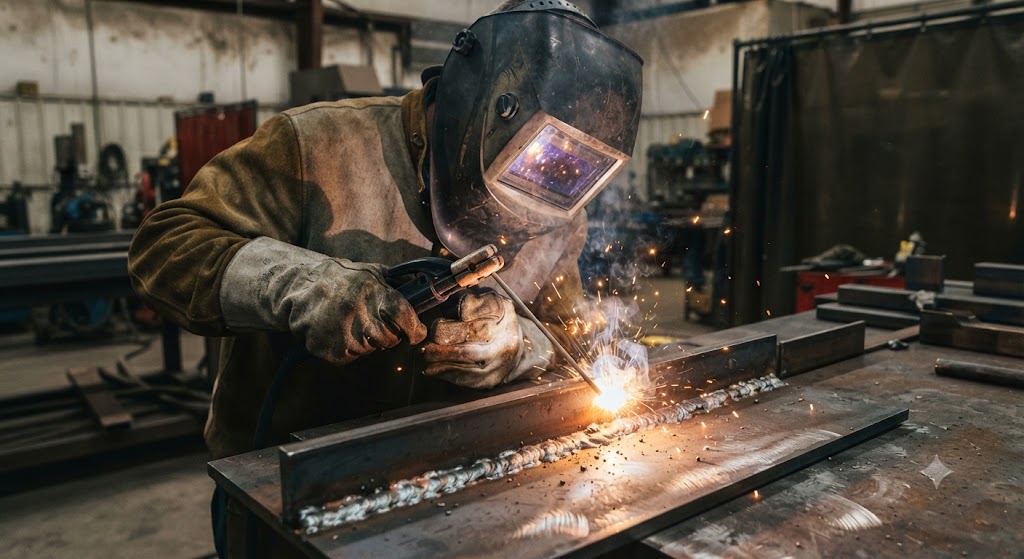
Direction of travel. Drag, do not push. With flux-cored wire, pulling the gun away from the finished bead lets the slag trail behind the puddle instead of getting rolled into it. Pushing gives you slag inclusions and that porous, ropey look people mistake for bad machine output.
Clean metal. Flux-cored wire is more forgiving of mill scale and rust than solid wire with gas, which is the honest reason it exists. Forgiving is not immune. A wire brush and thirty seconds pays for itself.
Where these machines fall short
The fan-cooled duty cycle is the first wall. Twenty to thirty percent at 90 amps means roughly two minutes of arc time in every ten. On short repair welds you will never notice. On a long run of fence rail you will be standing around waiting for the thermal light to go out.
The second wall is finish. Flux-cored welds throw spatter and leave slag. There is no version of that process that produces the clean, stacked-dime look of gas MIG on clean steel, and no setting on a 125-amp flux machine will get you there.
The third is consumables and support. The gun on the entry-level units is basic, and parts availability depends on your local store. A replacement wire feeder motor for the Chicago Electric Flux 125 is sold as an aftermarket part, which is useful to know and also tells you something about how these machines age.
What to buy instead, and when
If you have decided that flux-cored, 120V, quarter-inch-and-under is your world, the honest comparison is not Harbor Freight against Miller. It is Harbor Freight against the other machines in the same class.
The Forney Easy Weld 140 FC-i gives you 140 amps instead of 125, a rated plate range up to a quarter inch, infinite voltage and wire speed control, and a corner-protected metal case. Nineteen pounds, an eight-foot gun and ground clamp. It is the machine to buy if the Harbor Freight unit’s thickness limit is the specific thing stopping you.
The honest flaw: it is still gasless only, still 30 percent duty cycle at 90 amps, and Forney itself notes that running .035 wire reduces that duty cycle further. It does not solve the finish problem, only the capacity one. Anyone who wants clean welds should skip both and buy a gas-capable machine.
The Lincoln Weld-PAK 90i FC goes the other direction: less output, 30 to 120 amps, fifteen pounds, a metal carrying case and a shoulder strap. Lincoln rates it to a quarter inch on flux-cored wire. It is the one to pick if portability and a support network matter more than the last twenty amps. Skip it if you need a machine that will ever run gas, because it will not.
If gas is in your future at all, the Lincoln POWER MIG 215 MPi is the jump: dual voltage, an all-metal wire drive, MIG, flux-cored, stick and DC TIG, and 20 to 220 amps on 230V. It is a different category of purchase and a different category of result, and it is far more machine than a fence repair needs.
The verdict
A Harbor Freight wire feed welder is the right purchase for one specific person: someone who wants to find out whether they like welding, on mild steel, under a quarter inch, where function beats appearance. For that person it is a good buy and the money saved goes into wire, a decent auto-darkening helmet and practice, which is where it should go anyway.
Three things worth knowing before you decide. The Titanium inverter models are meaningfully easier to weld with than the transformer-based Flux 125, and the continuously variable control is why. The published 3/16 inch rating is a real ceiling, not a conservative guess, and the projects that fail are the ones that ignore it. And the finish quality ceiling is set by the flux-cored process itself, so if clean beads are the goal, no amount of practice on a gasless machine gets you there.
Start cheap, learn the puddle, and let the work tell you when you have outgrown the tool. That moment is obvious when it arrives.
Frequently asked questions
How thick can a Harbor Freight 125 amp welder weld? The manufacturer rates it for 18 gauge to 3/16 inch mild steel in a single pass. Thicker material can be joined with bevels and multiple passes, but penetration is limited and it is not appropriate for load-bearing work.
Can a Harbor Freight wire feed welder weld aluminum? No. The flux-core machines are specified for mild and low alloy steel only. Aluminum requires either a spool gun with a gas MIG machine or a TIG setup, neither of which the 125-amp flux units support.
Is the Titanium Easy-Flux 125 better than the Chicago Electric Flux 125? For most users, yes. Both produce 125 amps, but the Titanium is an inverter, weighs about fifteen pounds instead of forty-plus, has a 30 percent duty cycle at 90 amps rather than 20, and offers continuously variable control instead of fixed voltage taps.
Do I need gas with a Harbor Freight wire feed welder? The 125-amp flux machines cannot use gas at all. They run self-shielded flux-cored wire, where the shielding comes from the flux inside the wire. Only the multiprocess models in the lineup accept a gas connection.
Why are my welds so spattery? Usually polarity, travel direction or stickout. Flux-cored wire runs electrode negative, wants a dragging technique rather than pushing, and needs roughly three-quarters of an inch of stickout. Getting all three right transforms the arc.
What wire should I use? Use .030 self-shielded flux-cored wire for most work on a 125-amp machine. It feeds more smoothly than .035 and gives finer control on thin material. Move to .035 only at the top of the thickness range.
How long can I weld before it overheats? At 20 to 30 percent duty cycle at 90 amps, expect roughly two to three minutes of arc time in every ten, with the rest as cooling. Short repair welds rarely hit the limit. Long continuous runs will.
Is it worth buying a cheap welder to learn on? Yes, if you accept its range. The skills that matter, reading the puddle, travel speed, gun angle and joint preparation, transfer to any machine you buy later. Learning them on an inexpensive machine costs less than learning them on an expensive one.
References
- Harbor Freight Tools, Flux Wire Welder Owner’s Manual and Safety Instructions
- Harbor Freight Tools, Welders comparison
- Lincoln Electric, WELD-PAK 90i MIG specifications
- Forney Industries, 140 FC-i Welder specification sheet
- Lincoln Electric, POWER MIG 215 MPi Multi-Process Welder specifications