MIG Welding Wire: The Complete Buying Guide
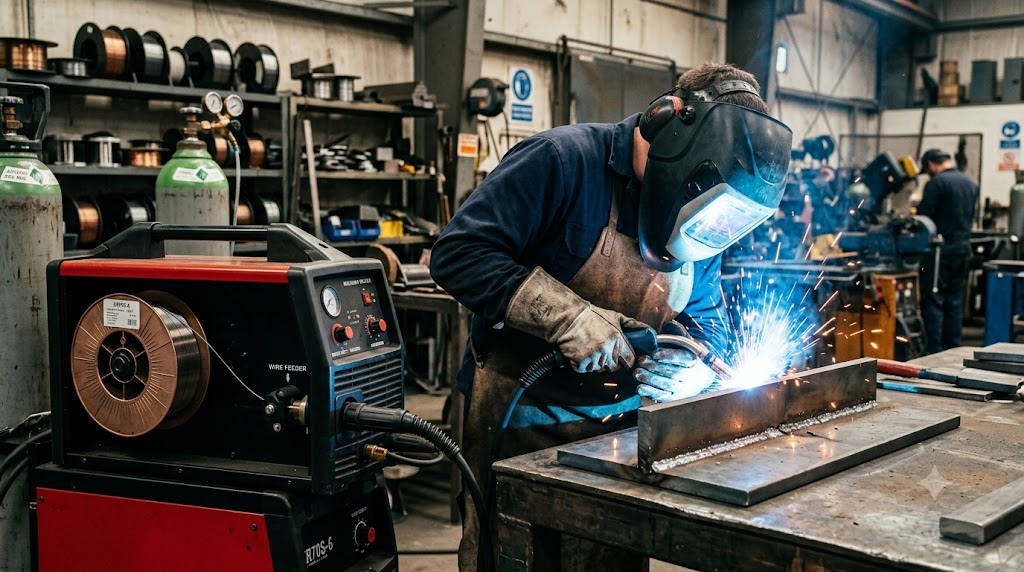
The wire is the one consumable a MIG welder eats constantly, feeding off the spool and turning into your weld inch by inch. Pick the right wire and the machine practically welds itself, laying smooth beads with a soft crackle. Pick the wrong one and you fight spatter, porosity, and feeding jams the whole time. For a process built on convenience, the wire choice is what makes or breaks the experience.
MIG welding wire comes in two main families: solid wire (which needs a shielding gas) and flux-cored wire (which shields the weld itself), with ER70S-6 being the standard solid wire for mild steel. Choosing the right wire means matching the type to your setup and metal, then picking the correct diameter for your material thickness. Here is how to get it right.
Solid wire versus flux-cored wire
The first fork in the road is which kind of wire your setup calls for:
- Solid wire (like ER70S-6) needs an external shielding gas (usually a 75 percent argon, 25 percent CO2 mix, or straight CO2) to protect the weld from the air. It gives clean, smooth welds with little spatter, but the gas bottle makes it less portable and poor in wind.
- Flux-cored wire has flux inside a tubular wire that shields the weld as it burns. Self-shielded flux core needs no gas bottle, so it is portable and works outdoors in wind, though it leaves more spatter and slag to clean.
If your welder has a gas bottle and you weld indoors on clean metal, solid wire is the smoother choice. If you weld outdoors, on thicker or dirtier steel, or want no gas bottle, flux core earns its keep.
Direct answer: which MIG wire should you use?
Start from your setup and metal:
- Mild steel, indoors, with shielding gas: ER70S-6 solid wire, the everyday standard.
- Mild steel, outdoors or no gas bottle: self-shielded flux-cored wire (E71T-GS for single-pass, E71T-11 for multi-pass).
- Stainless steel: ER308L solid wire for the common 304 grades (with the right gas).
- Aluminum: ER4043 or ER5356 solid wire, fed with a spool gun.
Then choose diameter by thickness: .030 inch for thin sheet and general light work, .035 inch for general to thicker material, and .023 inch for very thin sheet metal. For most home welders on mild steel, ER70S-6 in .030 or .035 inch covers the majority of jobs.
Why ER70S-6 is the default
ER70S-6 has become the standard mild steel MIG wire for a good reason: it is loaded with deoxidizers (high silicon and manganese) that fight porosity and let it weld cleanly even over light rust and mill scale. It runs well in all positions, works with straight CO2 or argon-CO2 mixes, and produces a flat, good-looking bead with low spatter. Rated at 70,000 PSI, it is strong enough for general fabrication, trailers, and structural repairs. Unless you have a specific reason to use something else, ER70S-6 is the wire to reach for on steel.
Matching wire diameter to thickness
Wire diameter controls how much current the wire carries and how much metal it deposits, so it should suit your material:
- .023 inch: very thin sheet metal (around 24 gauge to 1/8 inch), minimal burn-through risk.
- .030 inch: the do-everything home size, good from thin sheet up to about 1/4 inch.
- .035 inch: general to heavier work, roughly 14 gauge to 1/4 inch and thicker with multiple passes.
- .045 inch: thick, high-amperage industrial work.
One detail people forget: your contact tip must match the wire diameter exactly (a .030 wire needs a .030 tip). A mismatched tip causes erratic feeding and a wandering arc.
Which MIG wire to buy
Start with a quality ER70S-6 for steel, and add flux core if you weld outdoors.
- INEFIL ER70S-6 solid MIG wire (.030 inch, 10 lb spool) is a reliable everyday steel wire that feeds smoothly and welds cleanly with shielding gas, in the versatile .030 inch size most home machines like. Its limitation is that it requires a gas bottle, so it is not the choice for windy outdoor work.
- INETUB BA71TGS self-shielded flux-core wire (.030 inch, 10 lb spool) is the gasless counterpart, welding without a bottle and holding up outdoors and in wind, ideal for portable and field work. The trade-off is more spatter and slag to clean than solid wire.
How to decide: if you have shielding gas and weld indoors on clean steel, run ER70S-6 solid wire. If you weld outdoors, lack a gas bottle, or work on thicker or dirtier steel, keep a spool of self-shielded flux core on hand. Many welders own both.
Who should skip flux core: someone who only welds clean, thin sheet indoors with gas, where solid ER70S-6 gives a cleaner result with less cleanup.
The bottom line
MIG wire splits into solid wire, which needs shielding gas and welds cleanest indoors, and flux-cored wire, which shields itself and shines outdoors. For mild steel, ER70S-6 is the default for its clean, forgiving performance, and self-shielded flux core is the portable, wind-proof alternative. Match the wire diameter to your metal thickness (.030 or .035 inch covers most home work) and match your contact tip to the wire. Get those right and MIG lives up to its easy reputation.
FAQ
What is the best MIG wire for mild steel? ER70S-6 solid wire is the standard for mild steel, thanks to high silicon and manganese deoxidizers that weld cleanly even over light rust and mill scale. Use it with shielding gas in .030 or .035 inch for most home work.
What is the difference between solid and flux-cored MIG wire? Solid wire needs an external shielding gas and welds cleanly indoors with little spatter. Flux-cored wire carries flux inside that shields the weld itself, so self-shielded types need no gas and work outdoors, though it leaves more spatter and slag.
What size MIG wire should I use? Use .030 inch as a versatile home size (thin sheet up to about 1/4 inch), .023 inch for very thin sheet metal, and .035 inch for general to heavier work. Match your contact tip to the wire diameter.
Do I need gas for MIG wire? Solid wire like ER70S-6 needs shielding gas. Self-shielded flux-cored wire does not, which makes it portable and usable outdoors. Gas-shielded flux-cored wire still needs gas.
What MIG wire works for stainless or aluminum? Use ER308L solid wire for common 304 stainless and ER4043 or ER5356 for aluminum (fed with a spool gun). Each needs the appropriate shielding gas.
Why does my contact tip matter for wire size? The tip must match the wire diameter exactly (a .030 wire needs a .030 tip). A mismatched tip causes erratic feeding and an unstable arc.
References
- Miller Electric, MIG welding parameters and wire selection guidance, including wire size versus amperage (manufacturer), millerwelds.com.
- Hobart Brothers, ER70S-6 and flux-cored wire documentation and shielding gas recommendations (manufacturer).
- Lincoln Electric MIG (GMAW) wire selection guides and AWS A5.18 classification, lincolnelectric.com.