Stainless MIG Wire: How to Choose the Right Type
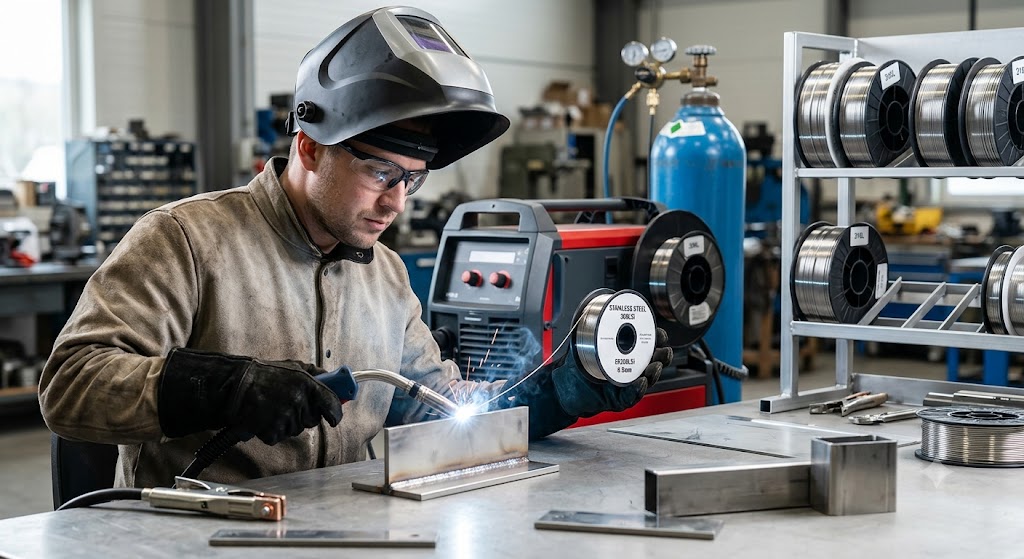
Stainless steel does not forgive the wrong filler. Use a mild steel wire on a stainless part and the joint rusts, cracks, or fails the moment it meets moisture or stress, undoing the entire reason you chose stainless in the first place. Getting the wire right is not a refinement here, it is the difference between a repair that lasts and one that quietly corrodes from the weld out.
Stainless MIG wire is a solid stainless filler matched to the grade of stainless you are welding, with ER308L being the standard for the common 304 and 304L grades. Choosing correctly means matching the wire to your base metal grade, using the right shielding gas, and understanding why the L (low carbon) designation matters for corrosion resistance. Here is the guide.
Why filler grade matters for stainless
Stainless steel resists corrosion because of its chromium content, and the weld has to preserve that protection. Using a mild steel wire on stainless contaminates the joint and destroys its corrosion resistance, so you must use a stainless filler matched to the base metal. The most common stainless grade in the wild is 304 (and its low-carbon twin 304L), used in kitchens, railings, tanks, and food equipment, and the standard filler for it is ER308L.
Match the filler to the grade and the weld keeps the corrosion resistance that made stainless worth using.
Direct answer: which stainless wire to use
Match the wire to your base metal:
- 304, 304L, 308, 321, or 347 stainless: ER308L, the everyday standard for the common 304 family.
- 316 or 316L stainless (marine, chemical, chloride exposure): ER316L, which adds molybdenum for extra corrosion resistance.
- Dissimilar joints, such as stainless to mild steel: ER309L, formulated to bridge the two metals.
For most people welding common 304 stainless (railings, brackets, food-grade repairs), ER308L in .030 or .035 inch is the right call. Step up to ER316L only when the part sees marine or chemical exposure, and use ER309L when joining stainless to carbon steel.
What the L means and why it matters
The L in ER308L stands for low carbon (maximum around 0.03 percent), and it is more than a technicality. When stainless is heated during welding, carbon can bind with chromium and form chromium carbides, which robs the surrounding metal of the chromium it needs to resist corrosion (a problem called sensitization or carbide precipitation). Low-carbon filler minimizes this, preserving corrosion resistance in and around the weld. For any stainless part that needs to resist rust and corrosion, especially in wet or corrosive settings, the low-carbon L filler is the safe choice. This is why ER308L, not plain ER308, is the common recommendation.
Shielding gas and technique
Stainless MIG has its own setup needs:
- Shielding gas: use a tri-mix (commonly helium, argon, and a small percentage of CO2) or an argon-based mix with low CO2 for short-circuit and spray transfer. Avoid straight CO2 or high-CO2 mixes, which add too much carbon and hurt corrosion resistance.
- Keep it clean: stainless is sensitive to contamination, so use dedicated stainless brushes and grinding tools that have never touched carbon steel, to avoid embedding steel particles that rust.
- Manage heat: stainless holds heat and warps easily, so control your heat input and avoid overheating the part.
- Diameter: .030 inch for thinner stainless, .035 inch for heavier work, with a matching contact tip.
Which stainless MIG wire to buy
Here are dependable ER308L options for the common 304 grades.
- ER308L stainless MIG wire (.030 inch, 10 lb spool) is a solid everyday choice for welding common 304 and 304L stainless in the versatile .030 inch size, with the low-carbon chemistry that protects corrosion resistance. Its limitation is that it is not for marine or chemical exposure, which calls for ER316L.
- Blue Demon ER308L stainless MIG wire (.035 inch, larger spool) suits heavier stainless work and longer runs, from a well-known welding wire brand, in the thicker .035 inch size. The trade-off is that .035 inch is easier to burn through on very thin stainless sheet.
- YESWELDER ER308L stainless MIG wire (.030 inch, 2 lb spools, 3-pack) is a convenient option for occasional stainless repairs, with smaller spools that suit light or infrequent use. The smaller spools mean less wire per reel for big projects.
How to choose: for common 304 stainless work, ER308L in .030 inch handles most jobs, with .035 inch for heavier material. Reserve ER316L for marine and chemical exposure and ER309L for joining stainless to mild steel. Always use dedicated stainless brushes and tools.
Who should skip ER308L: anyone welding 316 stainless in marine or chemical service, who needs ER316L for its added corrosion resistance, or anyone joining stainless to carbon steel, who needs ER309L.
The bottom line
Stainless MIG wire must match your base metal or the corrosion resistance is lost. ER308L is the standard for the common 304 and 304L grades, with the low-carbon L chemistry that protects against carbide precipitation and keeps the weld corrosion-resistant. Use the right argon-based shielding gas, keep dedicated stainless tools, manage your heat, and match diameter to thickness. Step up to ER316L for marine or chemical exposure and ER309L for dissimilar joints, and your stainless welds will hold up.
FAQ
What stainless MIG wire should I use for 304 stainless? ER308L is the standard filler for common 304 and 304L stainless, as well as 308, 321, and 347 grades. Use it in .030 or .035 inch with an appropriate argon-based shielding gas.
What does the L mean in ER308L? Low carbon (maximum around 0.03 percent). It minimizes chromium carbide formation during welding, which preserves corrosion resistance in and around the weld. That is why ER308L is preferred over plain ER308.
Can I use mild steel wire on stainless? No. Mild steel wire contaminates stainless and destroys its corrosion resistance, leading to rust and failure. Always use a stainless filler matched to the base metal grade.
What gas do you use for stainless MIG welding? A tri-mix (helium, argon, and a small percentage of CO2) or an argon-based mix with low CO2. Avoid straight CO2 or high-CO2 mixes, which add carbon and reduce corrosion resistance.
When should I use ER316L instead of ER308L? Use ER316L for 316 and 316L stainless and for parts exposed to marine, chloride, or chemical environments, where its added molybdenum gives extra corrosion resistance.
Why do I need separate brushes for stainless? Brushes or grinding tools that have touched carbon steel can embed steel particles in the stainless, which then rust. Use dedicated stainless brushes and tools to keep the surface clean and corrosion-resistant.
References
- Lincoln Electric and Hobart Brothers stainless steel filler metal selection guides, including ER308L, ER316L, and ER309L (manufacturers).
- American Welding Society AWS A5.9 stainless steel bare electrodes and rods classification, aws.org.
- Miller Electric stainless MIG welding shielding gas and technique guidance (manufacturer), millerwelds.com.