Tungsten Electrode Buying Guide for TIG Welding
The tungsten electrode is the tip of the spear in TIG welding, the point where the arc is born and where your weld quality is decided before the puddle even forms. Pick the right one and it starts easily, holds a sharp point, and burns clean. Pick the wrong one and you fight erratic starts, a spitting arc, and a tip that keeps balling up or contaminating your weld. The good news is that one modern electrode has made the choice a lot simpler than it used to be.
A tungsten electrode is the non-consumable metal rod that carries the arc in TIG welding, color-coded by the oxides added to it, and 2% lanthanated (blue) has become the best all-around choice for most welders. Choosing one means matching the electrode type to your current (AC or DC) and metal, then picking the right diameter for your amperage. Here is how to buy the right tungsten.
What tungsten electrodes are
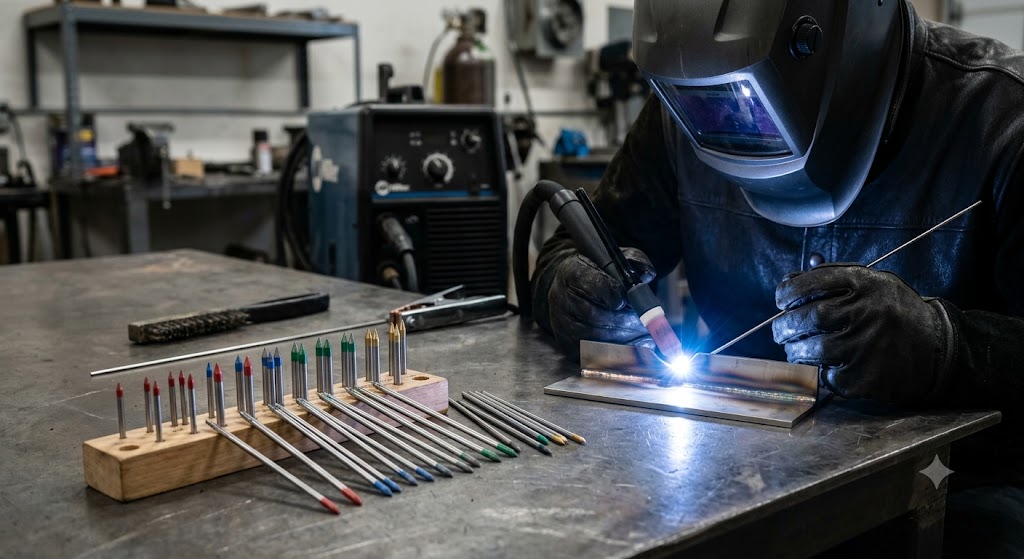
Tungsten has the highest melting point of any metal, which is why it can carry a TIG arc without melting away like a consumable filler. Pure tungsten alone works, but manufacturers add small amounts of oxides (like lanthanum, cerium, or thorium oxide) to improve arc starting, stability, and current capacity. Each additive gets a color code painted on the electrode tip so you can tell them apart.
The electrode does not melt into the weld. Instead, it sustains the arc while you add filler separately, which is what gives TIG its precision and clean appearance.
Direct answer: which tungsten should you buy?
For most welders, the simplest good answer is 2% lanthanated (blue), a true all-purpose electrode. Beyond that, match the type to your work:
- General all-around use, AC or DC, all metals: 2% lanthanated (blue). Excellent arc starts, handles high current without spitting, stable at low and high amperage.
- Low to medium amperage DC, thin materials and precision: 2% ceriated (grey). Easy low-amp starts, great for thin sheet and small parts.
- DC welding of steel and stainless, long electrode life: 2% thoriated (red). Durable and long-lasting, but contains a radioactive additive, so grind with care and ventilation.
- Aluminum on older transformer AC machines: pure tungsten (green), which balls up nicely for AC, though lanthanated has largely replaced it on modern inverters.
If you want to own one type and move on, buy 2% lanthanated.
Why lanthanated became the default
Lanthanated tungsten earned its popularity by doing everything well. Unlike thoriated, which is really a DC specialist and carries radioactivity concerns, 2% lanthanated works cleanly on both AC and DC, starts easily even at low amperage, holds a sharpened point, and resists spitting at high current. Miller and independent testers both single it out as the best single electrode for a welder who does not want to stock several types. Adding lanthanum oxide also raises the current-carrying capacity compared with pure tungsten. In short, it removed most of the reasons to agonize over the choice, which is exactly what a beginner wants.
Matching diameter to amperage
Electrode diameter has to suit your amperage, or the tip will either not hold a point (too small) or start poorly (too large for the job):
- 1/16 inch: low amperage, thin material and small parts.
- 3/32 inch: the versatile do-everything size for most hobby and general TIG work.
- 1/8 inch: higher amperage and thicker material.
A too-small electrode run at high amps overheats and the tip degrades; a too-large one at low amps starts poorly and wanders. When in doubt, 3/32 inch covers the widest range for general work. Always grind the point lengthwise (along the electrode), not across it, for a stable arc.
Which tungsten to buy
Here are dependable options covering the common types and the versatile 3/32 inch size.
- 2% Lanthanated tungsten electrodes (blue, 3/32 inch, 10-pack) are the best all-around pick, running cleanly on AC and DC across all metals with easy starts and a stable arc. Their only real limitation is that a dedicated DC-steel specialist may prefer thoriated for maximum electrode life.
- 2% Ceriated tungsten electrodes (grey, 3/32 inch, 10-pack) shine for low and medium amperage DC work on thin sheet and small parts, with excellent easy arc starts. The trade-off is that they are not recommended for high-amperage use, where the oxide migrates and degrades.
- 2% Thoriated tungsten electrodes (red, 3/32 inch, 10-pack) are the long-lasting DC choice for steel and stainless, durable and stable at moderate current. The catch is that thorium is radioactive, so grind with proper ventilation and dust collection, and they are not ideal for AC.
How to choose: if you want one electrode for everything, buy 2% lanthanated in 3/32 inch. Add ceriated for delicate low-amp work, and thoriated only if you do a lot of DC steel and want maximum electrode life (with careful grinding).
Who should skip thoriated: anyone welding aluminum on AC, or anyone who would rather avoid the radioactive additive entirely. Lanthanated or ceriated cover those needs without thorium.
The bottom line
The tungsten electrode decides your arc quality before the puddle forms, and 2% lanthanated (blue) has made the choice easy: it runs cleanly on AC and DC, on all metals, with great starts and a stable arc. Add ceriated (grey) for low-amp precision and thoriated (red) for long-life DC steel work, ground carefully. Match the diameter to your amperage (3/32 inch is the versatile all-rounder), grind the point lengthwise, and your TIG arc will start and hold like it should.
FAQ
What tungsten electrode should I use for TIG welding steel? 2% lanthanated (blue) is an excellent all-around choice that welds steel cleanly on DC. For maximum electrode life on DC steel and stainless, 2% thoriated (red) is the traditional pick, but grind it with ventilation because it is radioactive.
What is the difference between the colored tips on tungsten? The color code marks the oxide added to the tungsten: blue is 2% lanthanated (all-purpose, AC/DC), grey is 2% ceriated (low-amp DC), red is 2% thoriated (DC, radioactive), and green is pure tungsten (AC). Each affects arc starting, stability, and current capacity.
Do I need different tungsten for aluminum? Aluminum is welded on AC, so use an AC-capable electrode. 2% lanthanated (blue) works well on AC and is the modern choice. Pure tungsten (green) is the traditional AC electrode for older transformer machines.
What size tungsten electrode should I use? 3/32 inch is the versatile size for most general TIG work. Use 1/16 inch for low amperage and thin material, and 1/8 inch for higher amperage and thicker metal. Match the diameter to your amperage.
Is 2% lanthanated really the best all-around tungsten? For most welders, yes. It runs on both AC and DC, starts easily at low amperage, holds a point, and resists spitting at high current, which is why Miller and independent testers recommend it as the single best all-purpose electrode.
Why does my tungsten keep contaminating? Usually the tungsten touched the puddle or filler, or the arc length was too short. Grind off the contaminated tip (lengthwise), and keep the electrode out of the weld pool. A properly sized electrode for your amperage also helps.
References
- Miller Electric, All About Tungsten in TIG Welding: Types, Selection and Use (manufacturer), millerwelds.com.
- The Fabricator, Guidelines for tungsten electrode and color types (industry publication), thefabricator.com.
- ESAB, choosing the right tungsten electrode size and type, plus AWS A5.12 electrode classification, esab.com.