Welding Wire Selection Guide
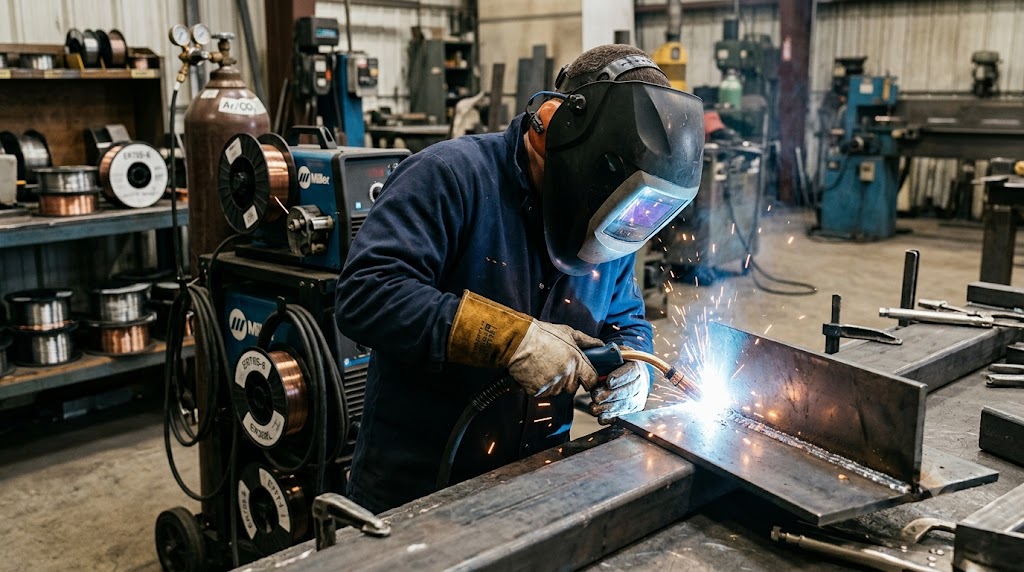
Choosing the right wire for MIG and flux-core welding determines weld quality, penetration, spatter level, and mechanical properties. This guide covers the most commonly used wire types and how to select the right wire for your application.
ER70S-6 vs. ER70S-3: What’s the Difference?
These are the two most common solid MIG wires for mild steel:
ER70S-6:
- Higher deoxidizer content (silicon and manganese)
- Works on lightly rusted, scaled, or dirty steel without porosity
- Better wetting action - flatter, wider bead profile
- Higher spatter than S-3 in some applications
- Most common wire for general shop and repair welding
- Available in 0.023”, 0.030”, 0.035”, 0.045”
ER70S-3:
- Lower deoxidizer content
- Requires clean, prepared steel for best results
- Better for production welding on clean new steel
- Less common in small shop and hobbyist environments
Recommendation for most welders: Use ER70S-6. The higher deoxidizer content provides more tolerance for real-world steel conditions (surface oxidation, light mill scale, minor contaminants).
Flux-Core Wire: Self-Shielded vs. Gas-Shielded
Self-Shielded Flux-Core (FCAW-S):
- Wire contains all flux needed for shielding - no external gas required
- Works outdoors and in windy conditions
- Common wire: E71T-11 (multi-pass capable), E71T-GS (single-pass only)
- Higher spatter than gas-shielded FCAW
- More smoke and fume than solid wire MIG
- Best for: outdoor structural work, repair welding, home welding without a gas bottle
Gas-Shielded Flux-Core (FCAW-G):
- Requires external shielding gas (typically 75/25 Ar/CO₂ or 100% CO₂)
- Higher deposition rate than solid wire MIG
- Better out-of-position capability than solid wire at equivalent settings
- Common wire: E71T-1C (CO₂), E71T-1M (mixed gas)
- Best for: Production welding, structural fabrication, heavy shop work
Wire Size Selection
| Material Thickness | Recommended Wire Diameter |
|---|---|
| 24–16 gauge (thin sheet) | 0.023” (solid wire) |
| 18–14 gauge | 0.030” |
| 3/16”–1/4” | 0.030”–0.035” |
| 1/4”–1/2” | 0.035”–0.045” |
| Over 1/2” | 0.045” or larger |
Thin sheet rule: When welding thin material (under 1/8”), use the smallest wire diameter your machine handles. Smaller wire provides lower minimum heat input and better control on thin metal.
Shielding Gas for Solid Wire MIG
| Gas | Performance |
|---|---|
| 100% CO₂ | Deeper penetration, higher spatter, lower cost |
| 75% Argon / 25% CO₂ (“C25”) | Lower spatter, smoother bead, slightly reduced penetration |
| 90% Argon / 10% CO₂ | Very low spatter, smooth bead, less penetration |
Most common shop choice: 75/25 Ar/CO₂ (C25) - balances spatter control and penetration. The industry standard for MIG welding mild steel.
Budget choice: 100% CO₂ - lower gas cost; more spatter cleanup required.
Stainless Steel and Aluminum Wire
Stainless steel MIG wire:
- Common grade: ER308L for 304 stainless steel
- ER309L for welding stainless to mild steel
- ER316L for 316 stainless (food service, chemical exposure)
- Shielding gas: 98/2 Argon/CO₂ (“tri-mix” for better wetting)
Aluminum MIG wire:
- ER4043 - general purpose; good flow, lower crack sensitivity
- ER5356 - higher strength; better for structural aluminum
- Requires 100% argon shielding gas
- Requires a Teflon liner in the gun liner to prevent wire shredding
- Push the gun (do not drag) for aluminum MIG
FAQs
What is the difference between ER70S-6 and ER70S-3? ER70S-6 has more deoxidizers and works on mildly dirty or scaled steel. ER70S-3 requires cleaner steel. ER70S-6 is the correct choice for most shop and repair welding.
What shielding gas should I use for MIG welding? 75% Argon / 25% CO₂ (C25) is the standard for solid wire MIG welding mild steel. It balances spatter control and penetration.
When do I use flux-core instead of solid wire MIG? Use self-shielded flux-core when welding outdoors or without a gas bottle. Use gas-shielded flux-core for high-deposition production welding in a shop environment.