Welding Boots Melting and Heat Damage: What Welders Need to Know
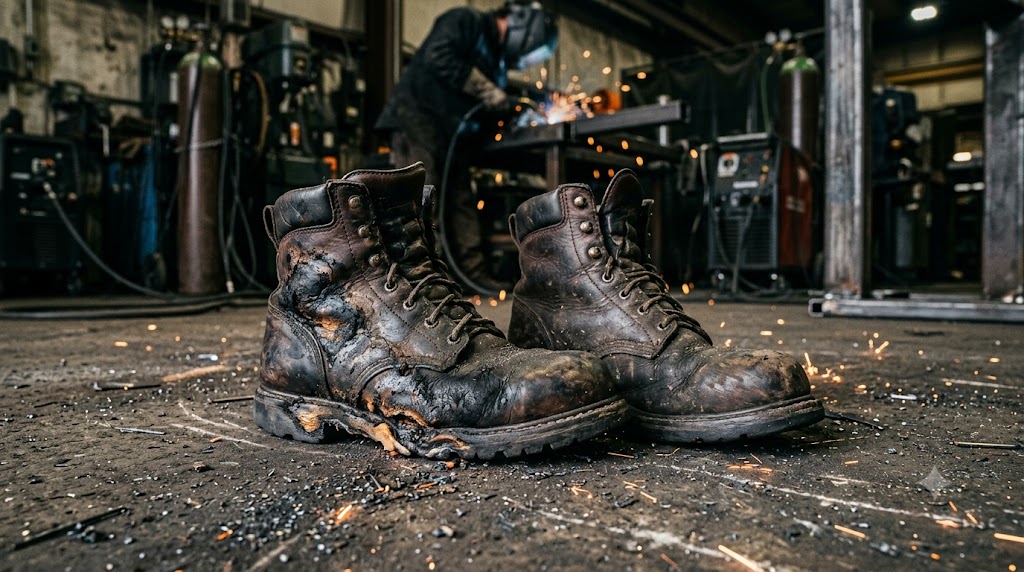
It starts as a smell. Burnt rubber, faint at first, then sharp enough to notice through the fumes. You look down and see a bubble on the toe box or a black scorch mark trailing across the sole. Your boots are melting, and you are standing on a floor covered in slag.
This is not a freak accident. It is what happens when the wrong boots meet the right amount of weld spatter, and it happens more often than most welders expect until it happens to them.
Why welding destroys the wrong boots
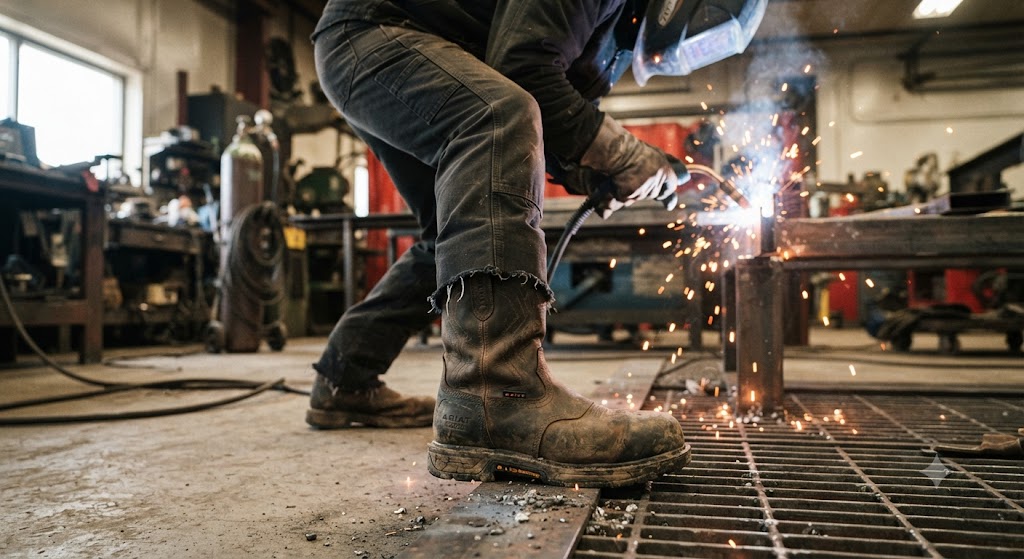
Standard work boots are not built for the welding environment. The outer sole on most safety toe work boots is rubber, which softens at roughly 150 to 200 degrees Fahrenheit and begins to degrade. Weld spatter lands at temperatures well above 2000 degrees. It does not need long contact to burn through rubber. A single piece of heavy spatter left on a boot for a few seconds is enough to leave a permanent mark.
The specific damage pattern depends on the process:
- MIG and stick welding throw the most spatter, and heavy globules that land on a boot toe or sole are the most common cause of direct melt damage.
- Grinding sends hot metal particles across a wide arc. These are smaller than weld spatter but accumulate on the toe box and laces over time.
- Overhead welding sends spatter directly down onto the top of the boot, where rubber midsoles and synthetic uppers are most exposed.
Synthetic uppers are the other major failure point. Nylon, mesh, and synthetic leather panels melt, char, and in some cases catch fire from sustained spatter exposure. Full grain leather uppers resist spatter far better: the leather chars before it burns, and a char mark is damage a welder can live with.
What makes a boot genuinely heat resistant for welding
A good welding boot is not just a work boot. It is a work boot that has been engineered to survive repeated spatter contact and thermal stress.
The sole is the first thing to evaluate. Leather soles or composite soles rated for heat resistance survive weld spatter better than rubber outsoles. Some modern safety boots use heat-resistant TPU or a layered sole construction where the outer surface handles spatter while the inner sole cushions the foot. Look for sole materials rated to at least 300 degrees Celsius (572 Fahrenheit) for sustained contact, which is the EN ISO 20345 standard designation for heat resistant soles.
The upper should be full grain leather with no mesh panels or synthetic sections at the toe box or the upper forefoot. Leather does not melt. It can take repeated spatter hits without compromising structural integrity.
No nylon laces. Nylon laces melt and snap on contact with spatter. Leather or Kevlar laces are the right choice in a welding environment. Some welding-specific boots are designed with the lace area tucked under a flap to reduce spatter exposure entirely.
Ankle height. A six to eight inch boot protects the lower ankle from spatter that misses the pant leg and deflects downward. Low cut work shoes have no place near a welding arc.
How to protect your boots from heat damage
Even with the right boots, extra steps extend their life.
- Wear FR welding pants or leathers that break over the boot. A pant leg that drapes over the boot top catches most spatter before it reaches the leather or sole.
- Use leather boot protectors or gaiters for heavy overhead or flat welding. These are slip-on leather or aluminized covers that protect the toe and instep from heavy spatter showers.
- Remove spatter with a chipping hammer before it embeds. Spatter that cools while in contact with a rubber sole can create small craters. Removing it while still detachable with a quick tap prevents that.
- Condition the leather regularly. Leather that is oiled and supple repels minor heat contact better than dry, cracked leather.
When to replace welding boots
Boots that show melt damage to the sole are not necessarily retired immediately, but inspect them carefully. A sole that has bubbled or melted through in an area near a safety toe insert may have compromised the insert’s connection to the boot. A cracked or separated sole in the toe area means the boot can no longer protect the foot from crush hazards as rated.
Any boot where the upper has burned through to the inner liner, where a lace retaining grommet has melted away, or where the ankle support feels soft or structurally compromised should be replaced. A boot is personal protective equipment, and a damaged one is not doing its job.
Frequently asked questions
Will regular work boots be ruined by welding? Often yes. Synthetic uppers and standard rubber soles are not built for sustained spatter exposure. A standard work boot can survive light welding, but a shop floor with heavy MIG or overhead work will damage or destroy an unsuitable boot within weeks.
What boots resist melting from slag best? Full grain leather upper boots with heat-rated composite or layered soles. Look for EN ISO 20345 compliant boots with an HI (heat insulation) or SRA/SRB sole rating and no synthetic panels on the upper. Brands like Red Wing, Thorogood, and Carolina make models specifically aimed at the welding and foundry trades.
How do you protect boot soles from welding heat? Wear welding pants that break over the boot to block most spatter. Use leather boot protectors for heavy overhead work. Remove spatter promptly before it embeds. Buy boots with heat-rated soles to begin with.
Can heat damage to a boot sole be repaired? Minor surface marks on leather soles can be dressed and conditioned. Structural sole damage, bubbling, or separation requires professional resoling or replacement. Do not try to patch a compromised sole with adhesive for a boot you wear in a welding environment.
Are composite toe boots better than steel toe for welding? For thermal comfort, yes. Steel toe inserts conduct heat, which becomes uncomfortable in very high thermal environments. Composite toe materials do not conduct heat and do not conduct electricity, which is a secondary benefit in arc environments. Safety ratings are equivalent for most applications.
Why do my boot laces keep melting? Nylon laces melt at temperatures well below weld spatter. Switch to leather or Kevlar laces. If spatter is reaching your lace area regularly, check your pant-to-boot overlap and consider a boot with a protective lace flap.
References
- Occupational Safety and Health Administration (OSHA), personal protective equipment standards for welding
- ASTM International, ASTM F2413, standard for performance requirements for foot protection
- EN ISO 20345, personal protective equipment safety footwear standard
- American Welding Society (AWS), welding safety guidelines