Welding Cap Catching Fire: Causes and Fire Resistant Options
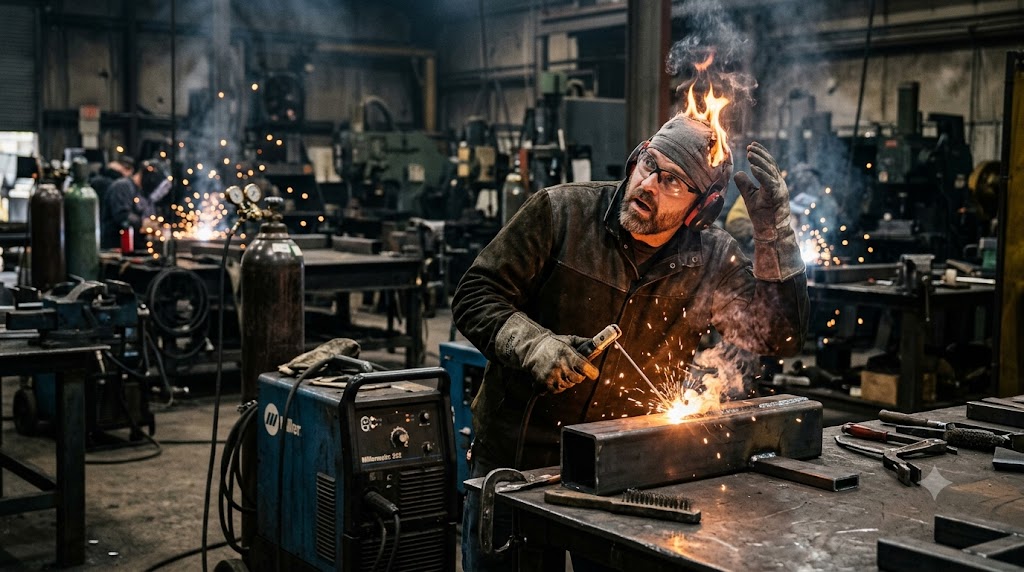
A welding cap sits directly on the heat source. It catches spatter. It absorbs infrared radiation. It sits between the top of your skull and an open arc, and most welders do not think twice about what it is made of until it starts smoking.
Welding caps can and do catch fire, and the material difference between a cap that chars and one that ignites is the difference between a minor annoyance and a genuine emergency.
Why welding caps catch fire
The problem is almost always material. A cap made of synthetic fabric or a cotton blend with no flame resistant treatment will ignite when it accumulates enough spatter. Spatter does not need to land in one large piece to cause ignition. Enough small hot particles landing in the same area over the course of a single session can heat the fabric to its ignition point.
The specific risk factors:
- Overhead welding. Spatter falls directly onto the top of the cap. This is when fire events are most likely.
- Stick welding and heavy MIG. These processes generate the most airborne spatter.
- Caps with poly-cotton or fully synthetic blends. Polyester ignites at roughly 480 to 500 degrees Fahrenheit and melts as it burns. Molten synthetic fabric is more dangerous than a charring natural fiber because it sticks to skin.
- Old caps with worn fabric. Thinning fabric, frayed edges, and holes give spatter direct access to the next layer.
The difference between fire resistant and fire retardant
This distinction matters and is widely misunderstood.
Fire resistant (or inherently FR) means the fabric is made from fibers that do not burn by nature. Nomex, Kevlar, and modacrylic are inherently fire resistant. You cannot wash out the protection because it is built into the fiber itself.
Fire retardant (or treated FR) means a chemical treatment has been applied to a fabric like cotton to reduce its flammability. This treatment works, but it degrades over repeated washing if the care instructions are not followed. Washed with bleach or fabric softener, or dried at high heat, a treated FR cap can lose a significant portion of its effectiveness.
For a welding cap, inherently FR fabric holds its protection for the life of the garment. Treated FR fabric requires care to maintain. Both are vastly safer than an untreated cap.
What a fire resistant welding cap actually provides
An FR welding cap does not make a welder fireproof. What it does:
- It does not ignite from spatter. The fabric chars at the contact point instead of catching. The char stops spreading when the heat source is removed.
- It does not melt. Unlike synthetic blends, FR natural fibers and inherently FR synthetics do not melt onto skin.
- It self-extinguishes. FR fabrics stop burning when the ignition source is removed. An untreated cotton cap may continue burning after the initial spatter contact.
These properties matter most during overhead welding, when the cap absorbs the highest concentration of falling spatter.
The brands most welders rely on
Comeaux Caps is the name that appears most in professional welding shops. They have been making welding caps in FR and non-FR materials for decades, and their FR cotton caps are a standard for welders who want reliable protection at a modest cost. Their caps are made in the US and available in multiple styles and fabric patterns.
ARCCAPTAIN and similar brands produce FR caps with modacrylic or treated cotton blends that are sold primarily online. Read the fabric specification before buying: look specifically for either inherently FR material or a certified treated FR cotton with washing instructions on the label.
Standard cotton caps without any FR treatment are sold in the same spaces as FR caps, and they are not always clearly labeled. If the cap does not specify an FR rating or FR material, assume it is not FR.
How often to replace a welding cap
Replace your welding cap when:
- The fabric is visibly thinning or has burn holes from previous spatter.
- The cap has been washed with bleach or fabric softener (for treated FR caps). The FR treatment may be compromised.
- Stitching is failing at the seams.
- The fit has changed enough that the cap no longer stays in position.
A welding cap is a low cost item in the context of the protective equipment it supplements. Replace it when it shows wear rather than waiting for a failure event.
Frequently asked questions
Can a welding cap catch fire? Yes. A cap made of untreated synthetic or poly-cotton fabric can ignite from accumulated weld spatter, particularly during overhead welding. FR caps are designed to char rather than catch and spread flame.
What makes a welding cap fire resistant versus fire retardant? Fire resistant (inherently FR) fabric is made from fibers that do not burn by nature, such as Nomex or modacrylic. The protection cannot be washed out. Fire retardant (treated FR) fabric has a chemical treatment applied to cotton that reduces flammability but can degrade with improper washing. Both are safer than untreated fabric, but inherently FR material holds its properties for the life of the cap.
How often should a welding cap be replaced? When the fabric shows thinning, burn holes, or failing seams. For treated FR caps, also replace if the cap has been washed with bleach or fabric softener, which can strip the FR treatment. A good rule for daily use is to inspect monthly and replace at any sign of structural or material compromise.
Is a standard cotton cap safe for welding? Untreated cotton will not melt onto your skin the way synthetics do, which is why many welders use standard cotton for light work. However, untreated cotton can and does ignite under sustained spatter exposure. For overhead welding or heavy production environments, use an FR cotton cap.
Can you wash a fire resistant welding cap? Yes, but follow the care label. Treated FR caps should be washed in cold or warm water without bleach, fabric softener, or high heat drying. These additives degrade the chemical FR treatment. Inherently FR caps can tolerate more varied washing conditions, but care labels still apply.
What material is best for a welding cap? Inherently FR materials like Nomex or modacrylic blends offer the most durable protection. Treated FR cotton is a practical and widely available option. Avoid polyester, poly-cotton blends, and acrylic in any welding cap.
References
- National Fire Protection Association (NFPA) 2112, standard for flame-resistant garments
- Occupational Safety and Health Administration (OSHA), personal protective equipment for welding
- American National Standards Institute (ANSI), guidelines on FR apparel care
- American Welding Society (AWS), welding safety practices