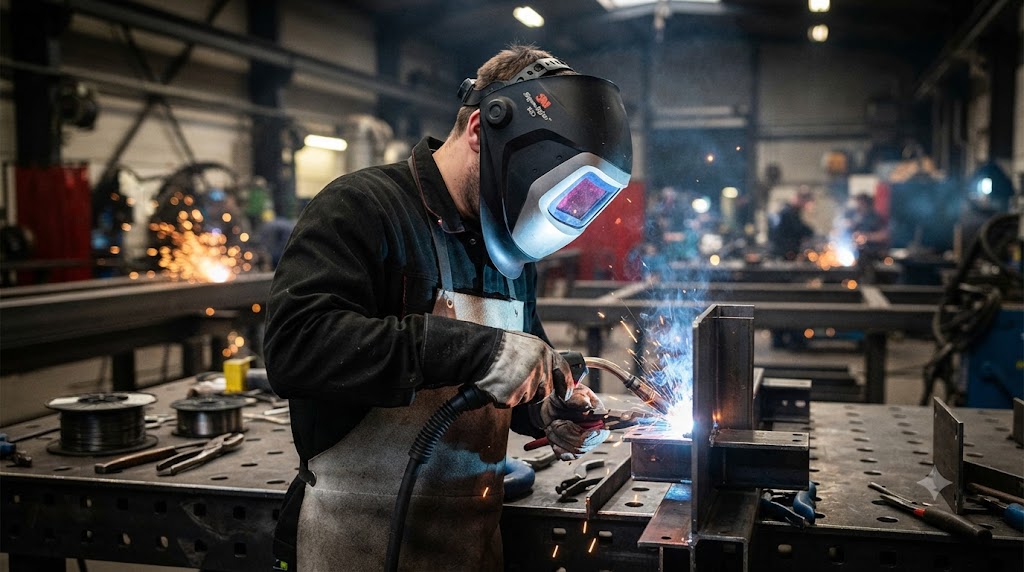
Cheap Welding Helmet Delay Too Slow: Why It Happens and How to Fix It
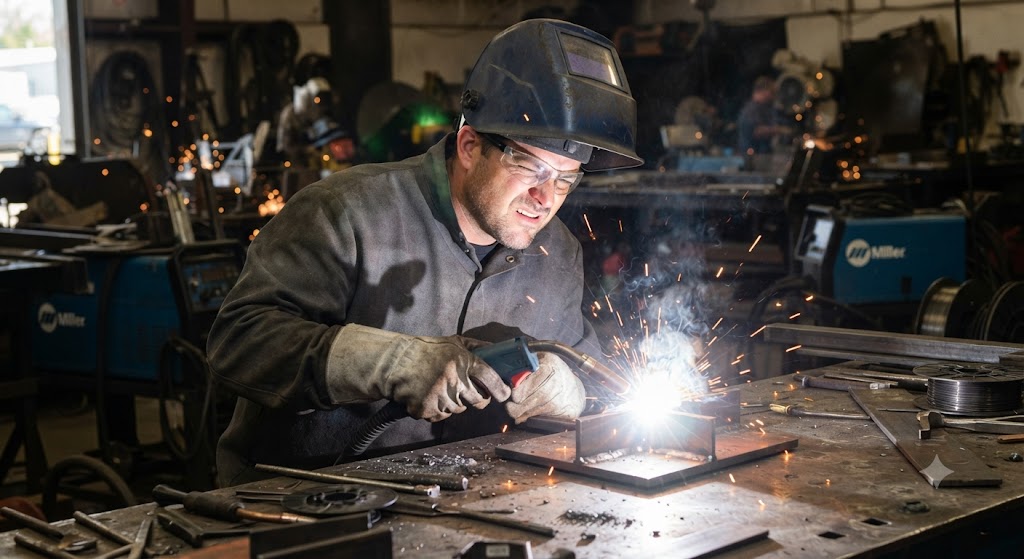
You pull the trigger and the arc fires. The helmet darkens, but a fraction of a second too late. By the time the lens reaches full dark, the arc has already lit up the inside of your eyelids. You blink and finish the weld, but your eyes are tired by midday and you know something is wrong.
A slow auto-darkening response is one of the most common complaints about budget welding helmets, and it causes real eye strain over time. Some cases are fixable. Others are the fundamental limit of a cheap lens.
What welding helmet response time actually means
Response time is the time it takes for the auto-darkening filter to switch from its light state to its fully dark state when it detects an arc. This is measured in fractions of a second.
A quality auto-darkening helmet switches in 1/25,000 of a second or faster. Budget helmets often spec 1/10,000 or even 1/3,600 seconds, which sounds fast in everyday terms but is significantly slower when measured against the speed at which an arc produces peak UV and IR radiation.
At 1/3,600 seconds, a helmet takes almost three times longer to darken than one rated at 1/25,000. Over a day of welding, that difference adds up in cumulative UV exposure and eye fatigue.
There is also a second “delay” setting, separate from response time, that controls how long the lens stays dark after the arc stops. This is the adjustable delay dial. Confusion between these two settings is common.
- Switching speed (response time) is a hardware specification. It is how fast the electronics can physically switch the LCD. You cannot change it with a dial.
- Delay setting controls how long the lens remains dark after the arc is gone. A delay set too long means you are looking through a dark lens while repositioning for the next tack. This is the adjustable one.
What you can actually fix on a slow helmet
Fix 1: Check the delay dial. If the lens is slow to return to the light state after the arc ends, the delay is set too high. This is not a response time problem: the lens darkened at full speed when the arc fired, it is just slow to reopen. Turn the delay dial toward the minimum setting. The lens will clear faster between welds.
Fix 2: Check the sensitivity dial. A sensitivity setting that is too low can cause the arc detection to lag. The sensors need a stronger signal to trigger, which means they may not fire until a fraction into the arc strike. Increasing sensitivity slightly can improve the apparent response at the start of a weld.
Fix 3: Clean the sensor windows and cover lens. Dirt on the sensor windows reduces the amount of arc light the sensors receive, forcing them to wait longer for a strong enough signal. A scratched or spattered cover lens scatters the arc light that reaches the sensors. Clean both with a soft cloth and check whether response improves.
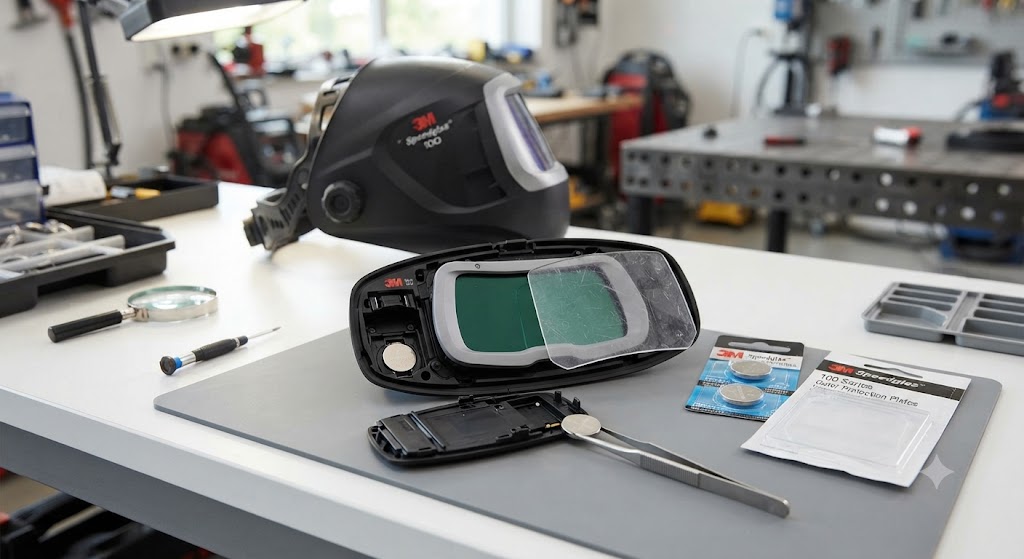
Fix 4: Replace the battery. A low battery weakens the electrical drive to the LCD and can cause the darkening transition to appear slower than specified. Replace the battery and retest.
What you cannot fix
If the switching speed of the ADF itself is too slow for safe welding, that is a hardware limitation. Budget helmets rated at 1/3,600 or 1/2,000 second switching speeds cannot be made faster by adjusting dials or cleaning sensors. The only fix is a replacement ADF or a new helmet with a faster lens.
For stick welding at high amperages, a slow response time is more consequential than for low-amperage TIG. The arc at 150 amps produces significantly more UV radiation than an arc at 50 amps, and every millisecond of unprotected exposure adds up.
The honest assessment: a helmet that switches at 1/3,600 of a second is not the same safety level as one at 1/25,000. If your eyes hurt at the end of a welding day, the helmet response time may be contributing, and no amount of dial adjustment will close that gap.
When a slow helmet is a signal to upgrade
The threshold that most professional welding safety guidelines use is a maximum 1/10,000 second switching speed for sustained production welding. If your helmet is rated below that and you are welding frequently, the eye strain is real and cumulative.
At this point the relevant question is not how to fix the helmet but whether the helmet is the right tool for the work you are doing. A helmet with a faster switching speed does not need to cost very much more, and the difference in eye comfort over a full shift is significant.
Frequently asked questions
Why is my cheap welding helmet slow to darken? The two most common causes are a hardware switching speed that is simply slower than mid-tier helmets, and a sensitivity or delay setting that is not optimized. Clean the sensor windows, replace the battery, increase sensitivity slightly, and reduce delay. If the problem persists, the ADF switching speed is the likely root cause.
Can you fix a slow auto darkening response? You can optimize the helmet through cleaning, battery replacement, and dial adjustment. You cannot change the fundamental switching speed of the ADF itself, which is a hardware spec.
Is delay lag a sign the helmet is failing? Not always. A high delay setting produces lag that feels like a slow response but is actually the lens correctly staying dark after the arc ends. If the delay setting is already low and the lens is still slow, it may be a battery issue or a genuinely slow ADF nearing end of life.
What switching speed should a welding helmet have? For production and professional welding, 1/25,000 of a second is the standard among quality mid-tier and professional helmets. A minimum acceptable threshold for sustained welding is generally considered 1/10,000 of a second. Helmets spec’d at 1/3,600 or slower are best suited for very occasional light use.
Will upgrading from a cheap helmet to a mid-tier one fix the slow response? Yes, in most cases. A Lincoln Viking 1740 or similar mid-tier helmet switches at 1/25,000 of a second, compared to 1/2,000 to 1/3,600 on many budget models. The difference in real world eye comfort during a full welding shift is noticeable.
Does the delay setting affect safety? Not directly. The delay controls how long the lens stays dark after the arc, which is a comfort and workflow setting. A delay set too long means you are looking through a dark lens between welds, which slows work and increases eye strain from squinting. It does not reduce UV protection while the arc is active.
References
- American National Standards Institute (ANSI) Z87.1, eye and face protection standard for welding
- Occupational Safety and Health Administration (OSHA), welding eye protection guidelines
- American Welding Society (AWS), welding safety practices
- Lincoln Electric, auto-darkening filter technical documentation