How to Store a Welding Helmet Properly
A welding helmet left on the bench gets a wrench laid across the lens. Left on the floor it gets stepped on. Left on a hook without a cover it collects shop dust in the sensor windows and spatter residue on the outside of the ADF. Most helmet damage between sessions is not from welding: it is from storage.
Storing a welding helmet correctly costs nothing and takes thirty seconds. The payoff is a lens that stays clear longer, an ADF that performs reliably, and a headgear assembly that does not crack from sitting in a compressed position.
The storage basics that apply to every helmet
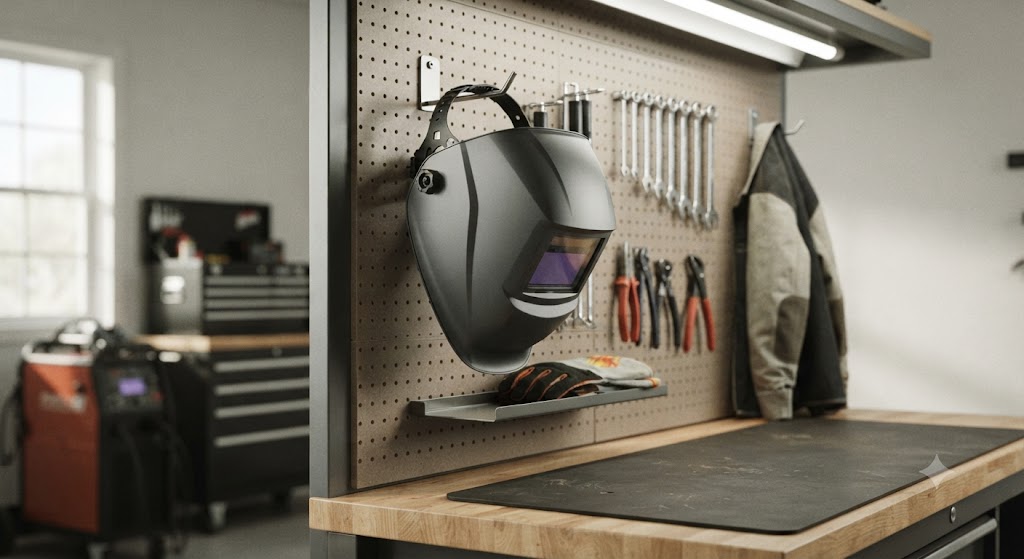
Store it face-up, in a bag, or on a dedicated hook.
Face-up protects the lens from contact with other surfaces. A bag, whether the fabric bag most helmets ship with or a simple padded case, keeps dust off the sensor windows and prevents incidental contact with tools and equipment. A hook mount keeps the helmet elevated and out of the way while allowing airflow around it.
Do not store it face-down. Face-down puts the entire weight of the helmet on the cover lens, and any debris on the surface beneath will scratch the lens. Even a shop table that looks clean has grit on it.
Keep it away from direct sunlight during long-term storage.
Extended UV exposure degrades plastic headgear components, dries out the gasket materials around the ADF, and can bleach the outer shell of the helmet over months. For daily-use helmets stored in a shop overnight, a couple of hours near a window is not a concern. For helmets stored for weeks or months, a cabinet or bag provides meaningful protection from UV.
Keep it away from heat sources.
A helmet left on a surface above a heater, or stored in a vehicle during summer, can warp the shell and degrade the seals and headgear plastic. ADF electronics are also temperature-sensitive: some manufacturers specify storage temperatures between roughly negative 20 and 70 degrees Celsius. A helmet left in a closed car in summer heat exceeds the upper end of that range.
The solar cell storage debate
This is the most common point of confusion about welding helmet storage.
Solar-assisted auto-darkening helmets have solar cells on the front of the shell that charge the battery backup when exposed to light. A common concern is that storing the helmet in the dark will drain the battery.
For most modern solar-assisted helmets, this is not a significant concern.
The battery in a solar-assisted helmet is a backup to the solar cell, not the primary power source. When the helmet is not in use, it draws almost no current. The battery will hold its charge for months in dark storage.
That said, storing the helmet where it occasionally gets ambient light exposure is not harmful and does keep the solar charge maintained. The best practical answer: store it in its bag or on a hook in a normal shop environment, not in a completely sealed box that gets zero light, and not in direct sunlight for extended periods. A shelf in a typical shop with natural or overhead lighting is fine.
Protecting the auto darkening filter between sessions
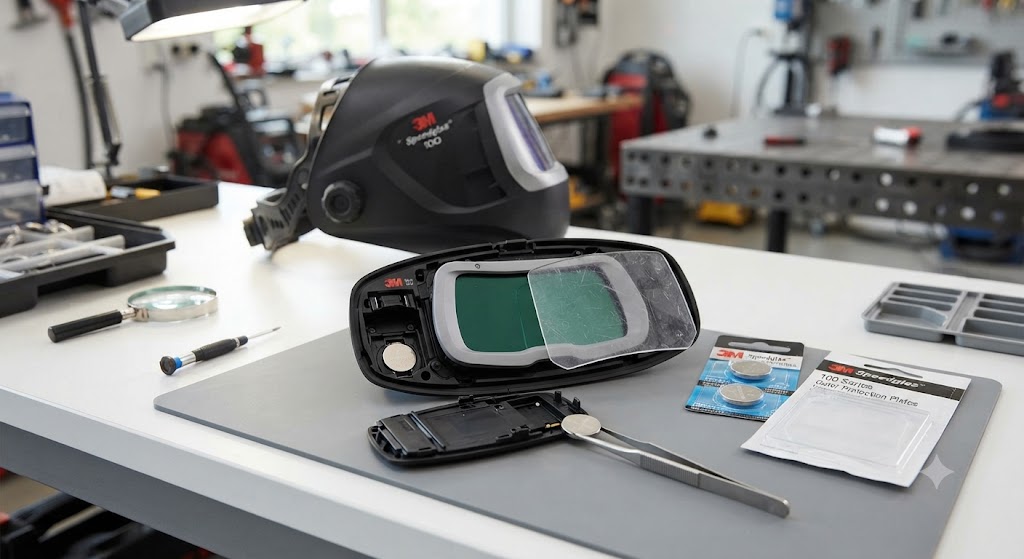
Replace the cover lens regularly. The cover lens is the outer plastic sheet in front of the ADF. It absorbs scratches, spatter, and dust so the ADF underneath stays clean. If the cover lens is heavily spattered, replace it before storage so you are not starting the next session with a compromised outer lens.
Clean the sensor windows before storing. A quick wipe with a clean damp cloth removes the spatter residue that builds up on the sensor windows during a session. Residue left on sensor windows between sessions hardens and becomes more difficult to remove.
Do not cover the lens with tape or adhesive materials. Some welders tape a cover lens to the ADF between sessions to protect it. This leaves adhesive residue on the lens surface. If you want to protect the ADF between sessions, keep the cover lens in place and store the helmet face-up or in a bag.
Headgear storage position
Store the headgear in a mid-tension position, not cranked fully tight. Leaving the ratchet wound to maximum tension puts constant stress on the headgear plastic and accelerates fatigue cracking at the ratchet housing. Loosen the ratchet slightly before hanging the helmet for storage.
Frequently asked questions
Should a welding helmet be stored in light or darkness? Neither extreme is ideal. Avoid direct sunlight during extended storage, which degrades plastic and UV-sensitive components. Avoid completely sealed dark storage for very long periods, which keeps the solar cell from topping up the battery. A shelf in a normal shop environment with ambient lighting is the right middle ground.
Does improper storage damage the auto darkening lens? Yes. A lens stored face-down picks up scratches. A lens in a dusty environment collects debris in the sensor windows. A helmet stored in high heat can warp the ADF housing and damage the seals. Simple storage habits prevent all of these.
How do solar-assisted helmets need to be stored differently? They do not need to be stored near a light source to maintain battery charge in most cases. The battery backup in a solar-assisted helmet holds charge for months. Store normally and the battery will be fine for any typical gap between uses.
Should I remove the cover lens before storing the helmet? No. Leave the cover lens in place during storage to protect the ADF. Replace it when it is heavily scratched or spattered, including before putting the helmet away if it is in bad shape.
Can I store my welding helmet in my car? For short periods in moderate weather, yes. Avoid leaving it in a vehicle during hot summer conditions where interior temperatures can reach well above the helmet’s rated storage temperature. Extended high-heat storage degrades headgear plastic, shell materials, and ADF seals.
Is a dedicated bag necessary? Not strictly, but it is the most practical solution. Helmet bags prevent dust accumulation on the sensor windows and lens, reduce incidental contact with other tools, and make it easier to carry the helmet to a job site without scratching the lens. Most quality helmets ship with a bag for this reason.
References
- Lincoln Electric, Viking series helmet care and storage guidelines
- Miller Electric, welding helmet maintenance documentation
- American National Standards Institute (ANSI) Z87.1, eye and face protection standard
- Occupational Safety and Health Administration (OSHA), welding PPE maintenance guidelines