How to Test if a Welding Helmet Is Still ANSI Compliant
You found a helmet in the back of the cabinet. It looks fine. The lens is clear, the headgear works, the shell has no cracks. You want to know if it is still safe before you put it on and strike an arc.
The ANSI marking on a welding helmet is not an expiration date. It is a certification that the helmet met a standard when it was manufactured. Whether it still meets that standard depends on what has happened to it since.
Here is how to assess it.
What ANSI Z87.1 actually guarantees
ANSI Z87.1 is the American National Standard for eye and face protection. For welding helmets, it sets requirements for:
- UV and IR filtration. The lens must block harmful ultraviolet and infrared radiation at all times, including when the auto-darkening filter is in its light (undarkened) state.
- Impact resistance. The shell and lens must withstand specified impact tests without cracking or shattering.
- Optical clarity. The lens must meet minimum standards for distortion and clarity.
- Marking. Compliant helmets carry specific markings including the ANSI Z87.1 designation and a shade number or range.
The marking tells you the helmet met those standards at the factory. It does not tell you whether a crack, a compromised ADF, or a deteriorated gasket has changed the picture since.
The tests you can run at home
These are practical field tests, not laboratory procedures. They are not a substitute for professional calibration, but they identify the failure modes that matter most.
Test 1: Light leak test
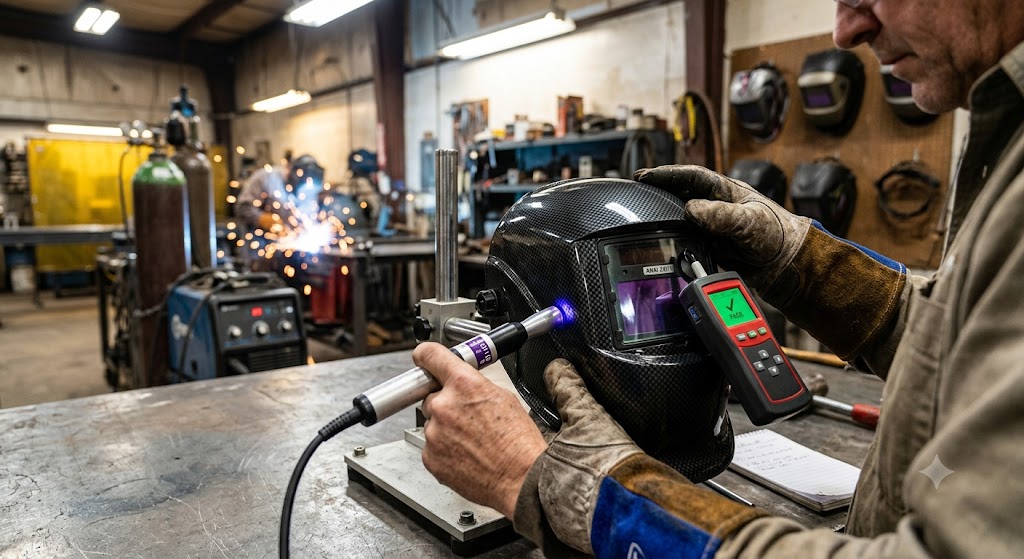
Take the helmet into a darkened room or a dim area. Hold the shell up to a bright light source (a lamp or bright window) and look through the inside. Any light entering through cracks in the shell, around the gasket seal between the ADF and the shell frame, or through holes in the shell is a failure.
Light leaks at the ADF perimeter mean UV and IR radiation can reach your eyes during welding even if the ADF is functioning correctly. A helmet with light leaks should not be used.
Test 2: ADF sensitivity test
With the helmet on and set to a normal sensitivity and delay setting, strike a short test arc or hold the helmet where it can see a briefly exposed arc from another welder (safely, not bare-eye). The lens must darken completely and nearly instantaneously.
If the lens darkens sluggishly, darkens partially, or fails to darken at all, the ADF electronics are degraded. A functioning ADF that switches slowly is not safe for welding.
Test 3: Shade test
With the helmet darkened, look at a bright surface. The viewing area should appear uniformly dark with no bright spots, lighter edges, or visible variation in shade across the lens. Inconsistent shading means the LCD cells in the ADF are failing.
Test 4: Physical inspection
Examine the helmet systematically:
- Shell. Check for cracks, deep gouges, and any impact damage that could compromise structural integrity. A cracked shell does not meet the impact protection requirements of ANSI Z87.1.
- ADF gasket. The rubber or foam seal around the ADF perimeter should be intact and compressible. A hardened, cracked, or missing gasket allows light to enter around the lens edge.
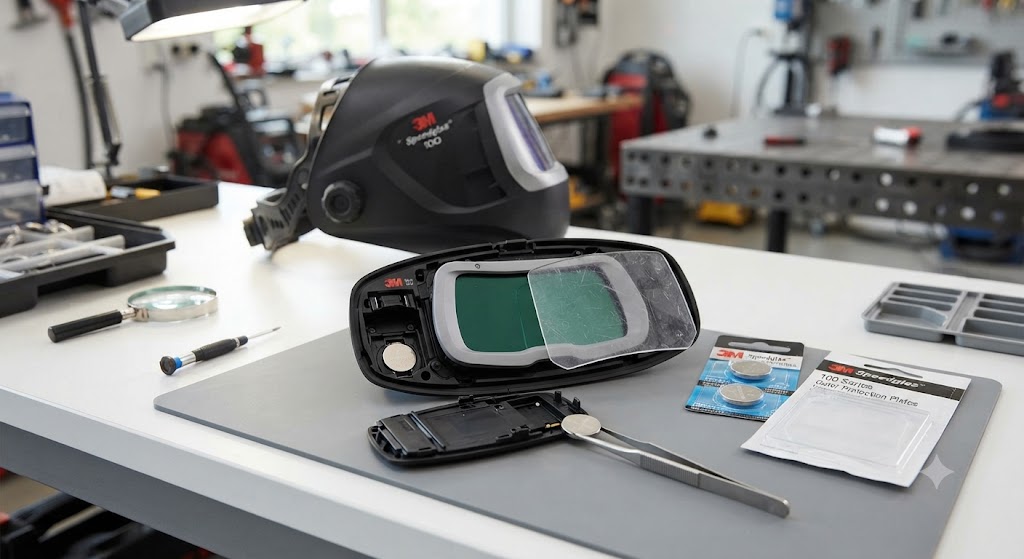
- Cover lens. Check that the cover lens is in place and not cracked. A missing or cracked cover lens removes the primary scratch and spatter barrier from the ADF.
- Headgear. A broken headgear does not affect the optical certification, but it means the helmet cannot be worn correctly.
Test 5: Check the date and known failure modes
Look for the manufacturing date or lot number printed on the helmet or ADF. Auto-darkening filters have a practical service life. Most manufacturers specify that ADFs should be replaced after a certain number of operating hours or years of service. ADFs in helmets that are more than seven to ten years old are worth testing carefully regardless of how they look.
What the ANSI Z87.1 marking does and does not cover
The marking guarantees that a helmet met the standard when tested. It does not:
- Guarantee the helmet continues to meet the standard after a drop, crack, or impact.
- Guarantee the ADF switching speed has not degraded over time.
- Guarantee the UV and IR coatings on the ADF lens are still intact.
The practical answer is that a helmet that passes all five tests above is likely still providing meaningful protection. A helmet that fails any one of them should not be used until the failing component is repaired or replaced.
When to replace instead of test
- Any helmet that has taken a significant impact to the face, even if no crack is visible. Internal damage can compromise the ADF housing and the optical coatings without obvious external signs.
- Any helmet where the ADF fails the sensitivity or shade uniformity test.
- Any helmet with a cracked shell or a missing or damaged ADF gasket.
- Any helmet where the manufacturing date is unknown and the origin is uncertain.
The cost of a replacement helmet is not large relative to the cost of an eye injury. When in doubt, replace.
Frequently asked questions
How do you test an old welding helmet at home? Run the five tests: light leak test in a darkened room, ADF sensitivity test with a live arc, shade uniformity check when darkened, physical inspection of shell and gasket, and review of the manufacturing date. A helmet that passes all five is likely still serviceable.
Do welding helmets expire or wear out of compliance? There is no formal expiration date, but the ADF has a practical service life. Optical coatings degrade, LCD cells age, and gaskets harden. A helmet that is more than seven to ten years old should be tested carefully and replaced if it fails any functional test.
What does the ANSI Z87.1 marking actually guarantee? It guarantees the helmet met the standard at the time of manufacture for UV and IR filtration, impact resistance, optical clarity, and labeling. It does not guarantee continued compliance after use, wear, or damage.
Can I weld with a helmet that has no ANSI marking? Not safely in a professional environment. OSHA requires welding eye protection to meet ANSI Z87.1 in most workplace settings. A helmet without the marking either was not tested or was manufactured before the standard. Neither is acceptable for production welding.
Does dropping a welding helmet mean I need to replace it? A significant impact, especially a drop onto a hard floor that lands on the lens or shell, warrants a thorough inspection. Run the full set of tests. If any cracks appear in the shell or the ADF darkening behavior changes after the drop, replace the helmet.
How do I know if the UV and IR protection is still working? UV and IR protection is built into the lens material and the ADF coatings. Physically damaged, cracked, or worn-through lens coatings are the main failure mode. A light leak test, a physical inspection of the lens surfaces, and an assessment of any physical damage to the ADF are the best field indicators.
References
- American National Standards Institute (ANSI) Z87.1, current edition, eye and face protection standard
- Occupational Safety and Health Administration (OSHA), 29 CFR 1910.133, eye and face protection requirements
- American Welding Society (AWS), welding safety practices
- Lincoln Electric, welding helmet service life guidelines