Welding Helmet and Gear Guide for Overhead and Out of Position Welding
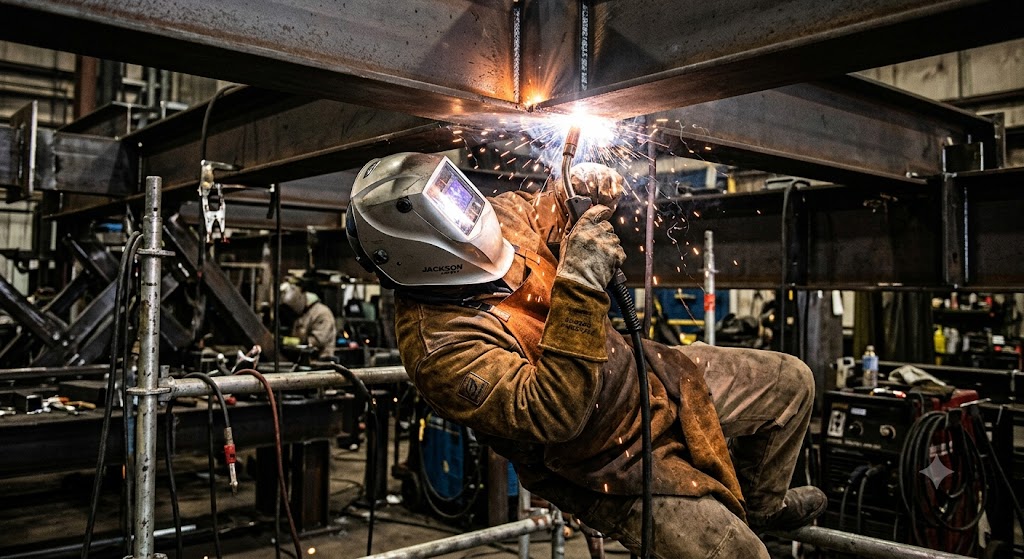
Overhead welding separates the gear you own from the gear you actually need. You strike an arc on a structural beam overhead, and within thirty seconds you’ve collected a slag trail across your cover lens, a drip of spatter on your neck, and a neck cramp from holding your head back while supporting the weight of your helmet. The average welding helmet was designed for someone sitting at a welding table with their head angled forward. Overhead work inverts every assumption.
Out-of-position welding — overhead, vertical-up, pipe at 5G and 6G — introduces problems that flat-position welding doesn’t: gravity pulls molten metal toward your face and helmet rather than away from it, your head is in an extended position that amplifies helmet weight, and your arc sensor angles are often awkward enough that two-sensor helmets miss starts entirely. The gear that handles these conditions has specific characteristics that aren’t obvious until you’ve spent a shift in the position.
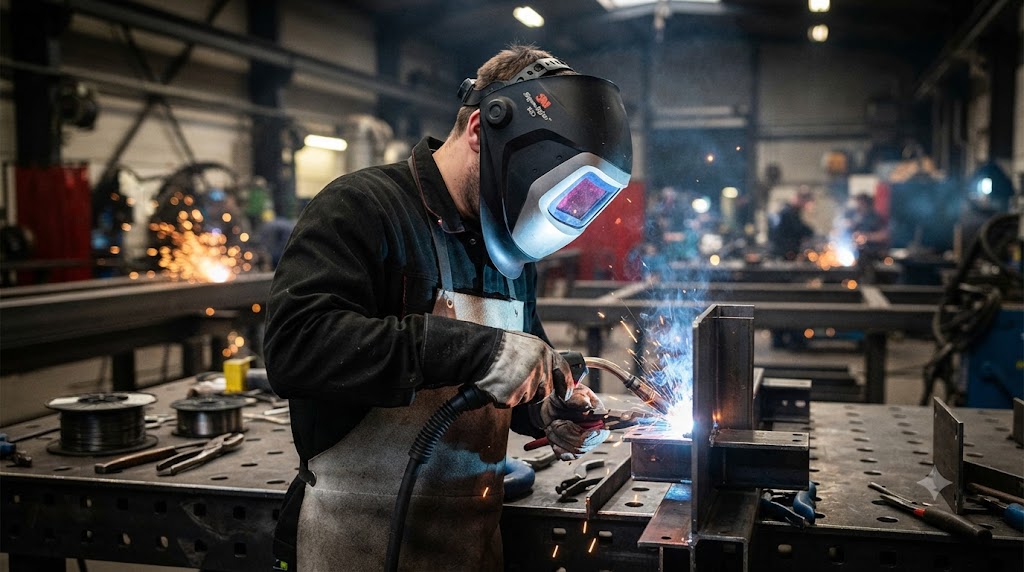
For overhead welding, the critical helmet features are four arc sensors for reliable triggering in any head position, a clear cover lens to protect the ADF from direct spatter contact, an FR (fire-resistant) welding cap to catch slag under the helmet shell, a ratchet headgear system that stays locked when your head is tilted back, and a helmet weight you can sustain for a full shift without neck fatigue. None of those features are exotic, but together they describe a specific tier of helmet that most budget units don’t reach.
The Four-Sensor Difference in Out-of-Position Welding
Arc sensors trigger the auto-darkening filter by detecting the UV and visible light signature of the arc. A two-sensor helmet places both sensors in the top corners of the lens frame. When you’re welding flat at a table, the arc is directly below the sensors — perfect geometry. When you’re overhead with your head tilted back, the arc is now below and behind the sensor plane. The sensors still see it, but at a reduced angle, and ambient light from above can fool the system or create a slow trigger response.
Four-sensor helmets add sensors in the lower two corners of the lens frame. In overhead position, those lower sensors face directly toward the arc. The trigger is faster and more reliable, and two sensors are effectively redundant — if one is blocked by your hand position or arm, two others are still watching the arc. On structural work where you’re moving around constantly and the arc angle changes with every position, four sensors is not a luxury feature.
Why You Need a Clear Cover Lens for Overhead
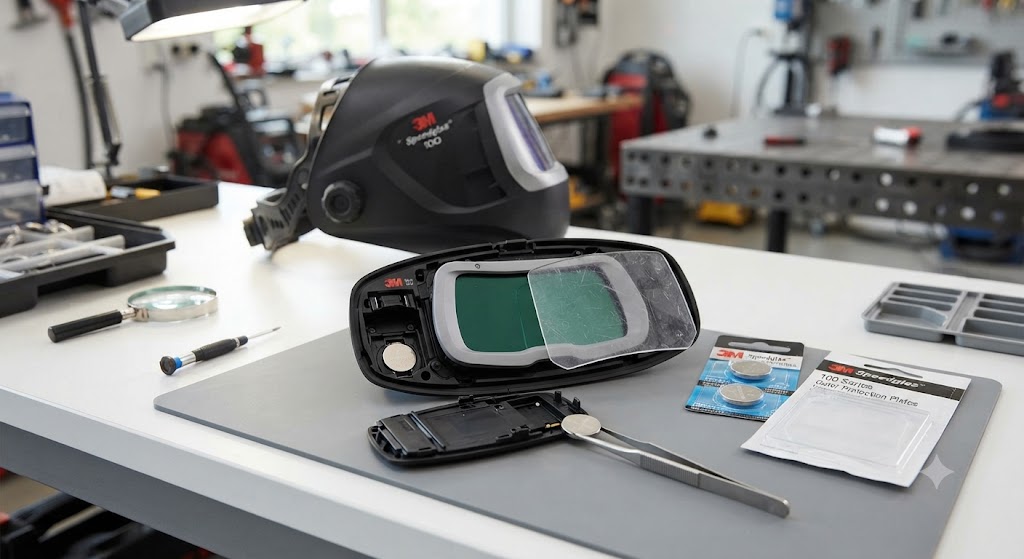
The outer cover lens on a welding helmet is a disposable sacrificial layer that sits in front of the ADF. It catches spatter, scratches, and arc flash. When you’re welding flat, spatter mostly falls away from you. When you’re overhead, spatter falls directly onto the cover lens at a higher velocity and with more direct impact.
A frosted or pitted cover lens reduces the optical clarity of even a 1/1/1/1 ADF behind it. A clear, undamaged cover lens is the difference between seeing the joint well and straining to find the puddle through haze. For overhead work, plan to replace cover lenses more frequently — after a full overhead shift rather than after a week of mixed-position work — and keep a supply on hand. Both the ESAB Sentinel A50 and Lincoln Viking 3350 use tool-free cover lens systems.
FR Cap: The Slag Catcher That Most Welders Skip
A fire-resistant (FR) welding cap is a fitted cap worn under the helmet that covers the top and back of your head. For flat-position work, it’s a comfort item. For overhead work, it’s a safety item. Slag and spatter that clears the helmet shell on an overhead pass has to land somewhere. Without an FR cap, it lands on your hair, your scalp, or the collar of your shirt. An FR cap stops that.
Caps made from FR cotton are comfortable for full-shift wear and wash easily. Avoid polyester-blend caps — they don’t meet FR requirements and can melt if hit by slag. The cap should fit snugly enough to stay in place when the helmet is on and your head is tilted back at full overhead extension.
Top Helmet Picks for Overhead Welding
Lincoln Electric Viking 3350
The Viking 3350 is the most consistent recommendation for out-of-position welding among professional welders, and the reason is the combination of four arc sensors, large viewing area, and ratchet headgear that locks firmly. The 12.5 square-inch lens is an active advantage overhead: you can see more of the joint without repositioning your head, which reduces neck strain over a long shift.
The 4C lens technology provides good color contrast on overhead joints where the weld pool is lit differently than it is in flat position. The X6 headgear has a slide-adjust front band that locks positively even when you’re pushing your head against the helmet in a confined overhead space.
Four arc sensors in the four corners of the lens frame give reliable triggering regardless of head angle. In 6G pipe position, where the arc angle changes constantly as you move around the pipe, four sensors mean the helmet keeps up with you rather than lagging.
The flaw: the Viking 3350 is on the heavier end of the professional ADF helmet range. For overhead structural work, that weight matters over a full shift — your neck holds not just the helmet but the weight of your head tilted back, and a heavy helmet makes that worse. If you’re doing continuous overhead work all day, consider the weight carefully against the Sentinel A50.
A verified live listing: Lincoln Electric Viking 3350
ESAB Sentinel A50
The Sentinel A50’s advantage for overhead work is weight and balance. Its low-profile shell and ergonomic Halo headgear place the center of gravity closer to your head than the Viking 3350’s larger shell does. Over a full overhead shift, that balance difference reduces neck fatigue in a way that’s hard to quantify on spec sheets but easy to feel by mid-afternoon.
The A50 also has four arc sensors and a shade range of 5-13 that covers overhead stick, TIG, MIG, and flux-core. The True Color ADF helps with overhead joint visibility: the warmer color tones make it easier to distinguish the puddle edge on vertical and overhead weld faces, which tend to show less contrast than flat-position welds in a standard green-tint lens.
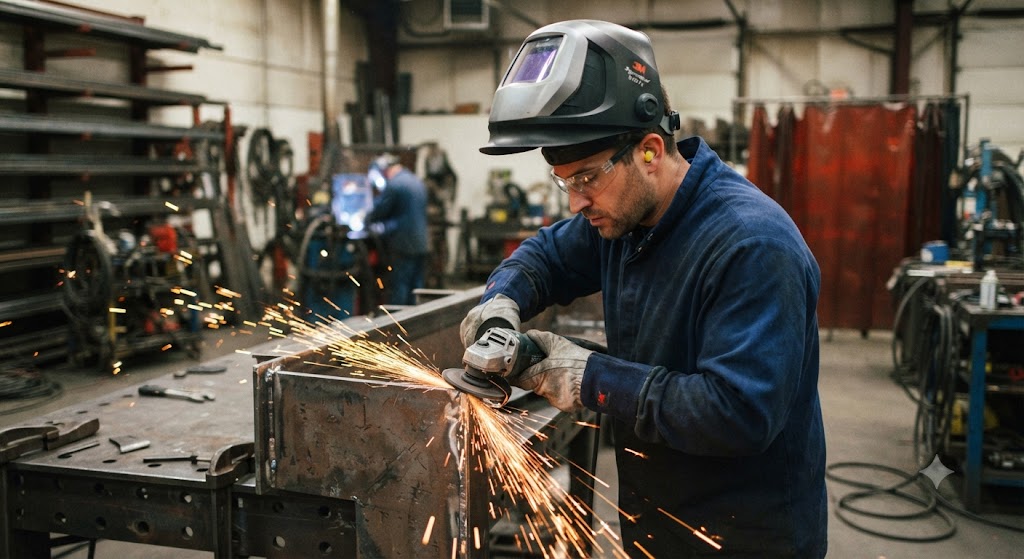
The external grind button activates shade 3 without menu navigation, which matters when you’re moving between grinding slag and rewelding overhead — a common cycle in structural work.
The flaw: the Sentinel A50’s viewing area (3.93” x 2.36”) is noticeably smaller than the Viking 3350’s 12.5 square inches. Overhead welding is already visually constrained, and a smaller lens window means more head repositioning to track the joint. Welders doing wide-bead or multi-pass overhead work will feel that limitation more than single-pass root welders will.
A verified live listing: ESAB Sentinel A50
Overhead Helmet Comparison
| Feature | Lincoln Viking 3350 | ESAB Sentinel A50 |
|---|---|---|
| Optical clarity | 1/1/1/1 (4C) | 1/1/1/2 (True Color) |
| Viewing area | 12.5 sq. in. | 3.93” x 2.36” |
| Arc sensors | 4 | 4 |
| Shade range | 5-13 | 5-13 |
| Headgear | X6 ratchet | Halo 5-point |
| Best overhead use | Multi-pass, wide view structural | Long shifts, weight-sensitive |
| Named flaw | Heavier than competitors | Smaller viewing area overhead |
Head and Neck Protection for Overhead Work
Beyond the helmet and FR cap, overhead welding demands attention to neck and upper chest protection. The gap between the bottom of your helmet shell and the top of your collar is where most spatter exposure happens in overhead position. A leather bib or FR-rated neck gaiter fills that gap. It doesn’t have to be fancy — a simple leather flap that attaches to the helmet’s chin area is enough — but skipping it means collecting spatter burns on your neck until you add one.
Long-sleeve FR clothing rather than just sleeves is worth the upgrade for consistent overhead work. When spatter is falling down your arms rather than off them, full FR jacket coverage from the cuff up to the collar keeps you from developing small burn injuries that compound over a shift.
FAQ
What helmet is best for overhead welding? The Lincoln Electric Viking 3350 and ESAB Sentinel A50 are both strong choices. The Viking 3350 is better if viewing area is your priority; the Sentinel A50 is better if you’re doing full-shift overhead work and weight matters. Both have four arc sensors, which is the non-negotiable requirement for reliable overhead triggering.
How do you keep slag from damaging your helmet when welding overhead? Replace outer cover lenses frequently and keep extras on hand. For overhead work, a clear cover lens may need replacement after a single shift rather than weekly. The cover lens is a consumable — replacing it is far cheaper than replacing a fogged ADF.
Do you need a different cap for overhead welding? An FR welding cap is strongly recommended for overhead welding. Standard cotton caps reduce slag contact with your scalp but don’t meet FR requirements. A dedicated FR welding cap (FR cotton or Nomex) prevents the cap itself from being a burn hazard when slag lands on it.
Why do two-sensor helmets struggle overhead? Two-sensor helmets place both sensors at the top of the lens frame. In overhead welding with the head tilted back, the arc is at an angle below the sensor plane. The sensors have a reduced view of the arc UV, which can cause slow or missed triggers. Four-sensor helmets add lower-frame sensors that face the arc directly in overhead position.
What ratchet headgear is best for overhead welding? A ratchet headgear with positive locking clicks — not friction-drag adjustment — is best for overhead work. Headgear that adjusts by friction can creep loose when you’re pushing your head against the shell in a confined space. The Lincoln X6 and ESAB Halo headgear both use positive-click ratchet systems.
Does optical clarity matter more for overhead welding? Yes. Overhead joints are often in shadow or in variable lighting, and the overhead weld pool is lit differently than a flat bead. A 1/1/1/1 optical clarity lens shows you the pool and the joint edge with less distortion than lower-rated optics, which helps you track the bead line when you can’t use gravity or fixture position as a visual reference.
What shade do I use for overhead stick welding? OSHA 1915.153 Table I-1 sets the minimum for shielded metal arc welding at shade 7 for under 60 amps, shade 8 for 60-160 amps, and shade 10 for 160-250 amps. Most overhead stick welding in structural work runs 80-160 amps (3/32” to 1/8” rod), which puts the practical shade at 10.
References
- https://www.osha.gov/laws-regs/regulations/standardnumber/1915/1915.153
- https://www.osha.gov/sites/default/files/publications/OSHAFACTSHEET-EYEPROTECTION-DURING-WELDING.pdf
- https://www.lincolnelectric.com
- https://www.esab.com
URL slug: overhead-welding-helmet Excerpt: Overhead welding needs four arc sensors, a clear cover lens, and an FR cap to catch falling slag. This guide covers the two helmets that handle all-day overhead work and the gear that rounds out your protection.