Welding Helmet Headgear Strap Broken: Repair or Replace
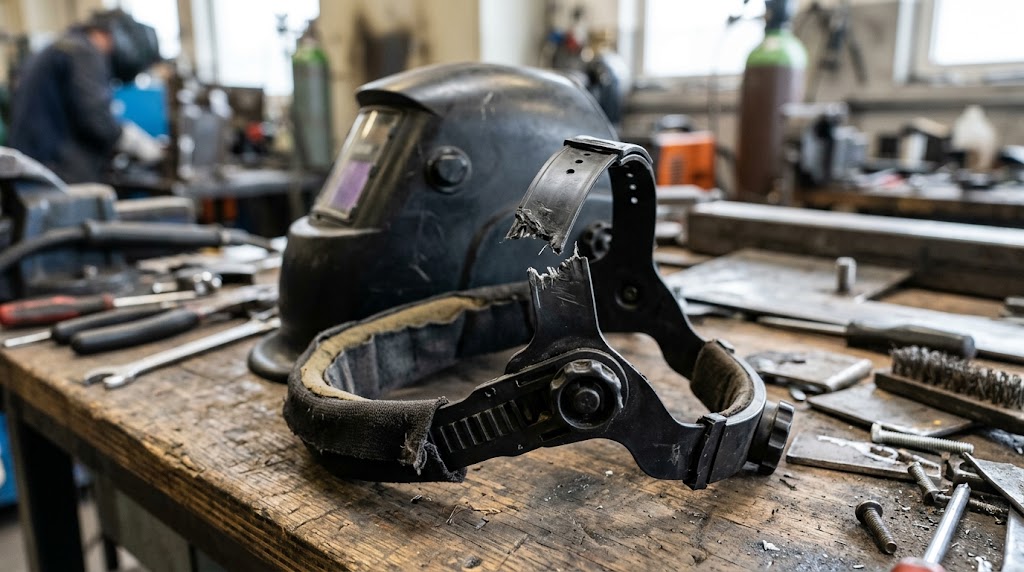
The ratchet clicks but the helmet slips. The strap snapped at a stress point. The pivot joint cracked and the shell tilts at an angle that puts the lens nowhere near your line of sight. You have a helmet that works perfectly and a headgear assembly that has failed, and you are standing in the shop wondering whether to fix it or buy a new one.
This is a common situation with a clear answer: replace the headgear, not the helmet.
What is inside a welding helmet headgear assembly
The headgear on an auto-darkening welding helmet is a separate component from the shell and the lens. It connects to the helmet at two or four attachment points and handles all the weight distribution, tilt, and fit functions.
The major components:
- The main crown band, which goes over the top of the head and sets the basic fit.
- The ratchet mechanism at the back, which tightens the headband to the head circumference.
- The sweatband, the soft inner lining that contacts the forehead. This is the first part to wear out on most headgear assemblies.
- The pivot arms, which attach the shell to the headgear and allow the helmet to flip up.
- The tilt adjustment, which sets the angle of the shell relative to your face.
On most helmets, these components are made from injection-molded plastic with a nylon sweatband. The ratchet mechanism and pivot arms are the first structural components to crack or strip under normal use, typically at the joints and adjustment points.
Can a broken strap be repaired?
Sometimes. The answer depends on which part broke.
Sweatband worn out. The sweatband is almost always replaceable on its own. It clips or snaps into the crown band on most headgear assemblies. Replacement sweatbands are sold for most popular helmet headgear models and cost very little.
Ratchet mechanism stripped. The ratchet clicks but no longer holds the adjustment. This is usually not field-repairable. A stripped ratchet means the helmet cannot hold its fit position, which is a real functional problem if the helmet shifts while you are welding. Replace the headgear assembly.
Strap or band cracked at a joint. A crack at a stress point on a plastic strap or the main crown band is a break that will continue to propagate with use. Zip ties and tape are not appropriate fixes for the primary structure of a welding helmet headgear. Replace the assembly.
Pivot arm broken. The pivot arms that attach the shell to the headgear take significant mechanical stress when the helmet is flipped up and down. A cracked or broken pivot arm should be replaced. Some manufacturers sell pivot arms separately; on others, the whole headgear assembly is the replacement unit.
Are headgear straps universal?
No, but there is a widely available aftermarket standard. Jackson Safety 370 headgear fits a large number of helmet brands and models beyond Jackson’s own products. Welders frequently use the 370 as a replacement for worn-out headgear on helmets where the manufacturer’s own replacement part is hard to find or expensive.
Fibre-Metal headgear is another widely used assembly with broad compatibility. It is commonly found in industrial safety supply channels.
Before ordering a replacement, note the attachment type on your current helmet. Most auto-darkening helmets use either a four-button attachment system or a two-clip system on the shell interior. The replacement headgear must match your helmet’s mounting points. Check your helmet manufacturer’s website or the helmet documentation for the correct part number.
Brand-specific headgear availability
For the major helmet brands, replacement headgear is consistently available:
- Lincoln Electric Viking helmets use Lincoln’s X6 headgear on current production models. Replacement headgear assemblies are sold through Lincoln Electric dealers and major welding supply stores.
- Miller helmets use Miller’s Legacy headgear, sold directly and through distributors.
- ESAB Sentinel helmets use the Halo headgear, available through ESAB dealers.
- Hobart and Antra use standard four-point mounting headgear available from the manufacturer and through third-party options like the Jackson 370.
For budget helmets where manufacturer support is thin, the Jackson Safety 370 headgear is the most practical solution if the mounting points are compatible.
How often does headgear need replacing?
For daily industrial use, headgear assemblies typically last one to three years before the ratchet loosens, the pivot arms fatigue, or the sweatband wears through. Hobby welders with light use can go much longer.
The sweatband needs more frequent attention than the rest of the assembly. Wash or replace it every three to six months on a helmet used daily. A saturated sweatband transfers moisture to the inside of the helmet shell and accelerates the degradation of the headgear plastic over time.
Do not wait for a complete failure to replace a headgear that is behaving poorly. A helmet that shifts during welding is a safety problem.
Frequently asked questions
Can a broken welding helmet strap be repaired? The sweatband can usually be replaced without tools. A cracked plastic crown band or broken pivot arm should be replaced at the assembly level. Structural repairs with tape or zip ties are not appropriate for a safety item.
Are welding helmet straps universal across brands? Not exactly, but Jackson Safety 370 headgear fits many helmet brands beyond Jackson’s own products and is a widely used aftermarket replacement. Check the mounting attachment type on your helmet before ordering.
How often do headgear straps need replacing? For daily industrial use, one to three years is typical for the full assembly. The sweatband wears faster and should be replaced every three to six months under heavy use. Replace any headgear component that no longer holds adjustment or has cracked at a structural point.
Is it worth replacing the headgear on a budget helmet? If the lens and ADF are still performing well, yes. A replacement headgear often costs less than a new budget helmet and extends the useful life of an otherwise functional piece of equipment.
What happens if I weld with a loose or broken headgear? The helmet can shift during welding and expose your eyes or face to the arc. A helmet that does not sit securely in position is a safety hazard, not just an annoyance. Fix or replace the headgear before continuing to use it.
Where can I buy replacement headgear? Through the helmet manufacturer, major welding supply stores, and online through retailers that carry welding safety equipment. Jackson Safety 370 headgear and Fibre-Metal headgear are widely available through industrial safety supply channels and online.
References
- Occupational Safety and Health Administration (OSHA), welding eye and face protection requirements
- American National Standards Institute (ANSI) Z87.1, eye and face protection standard
- Jackson Safety, headgear product specification documentation
- American Welding Society (AWS), welding PPE guidelines