Welding Helmet Lens Scratched: What to Do and How to Fix It
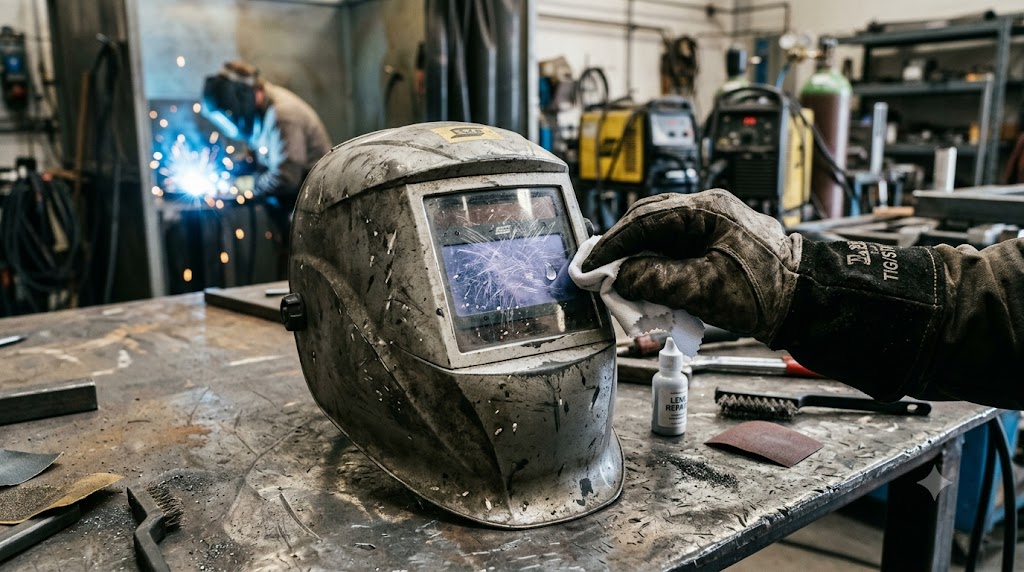
You put on the helmet and look through the lens and something is wrong. A web of fine scratches scatters light across the center of the viewing area. A deeper gouge splits your line of sight. You can weld, but you have to tilt your head to see the puddle cleanly, and by the end of the shift your eyes are tired.
A scratched welding lens is one of the most common maintenance issues welders face, and one of the most consistently mishandled. The fix is usually straightforward, but the wrong approach makes it worse.
Understanding what you are looking at
A modern auto-darkening welding helmet has two separate optical elements:
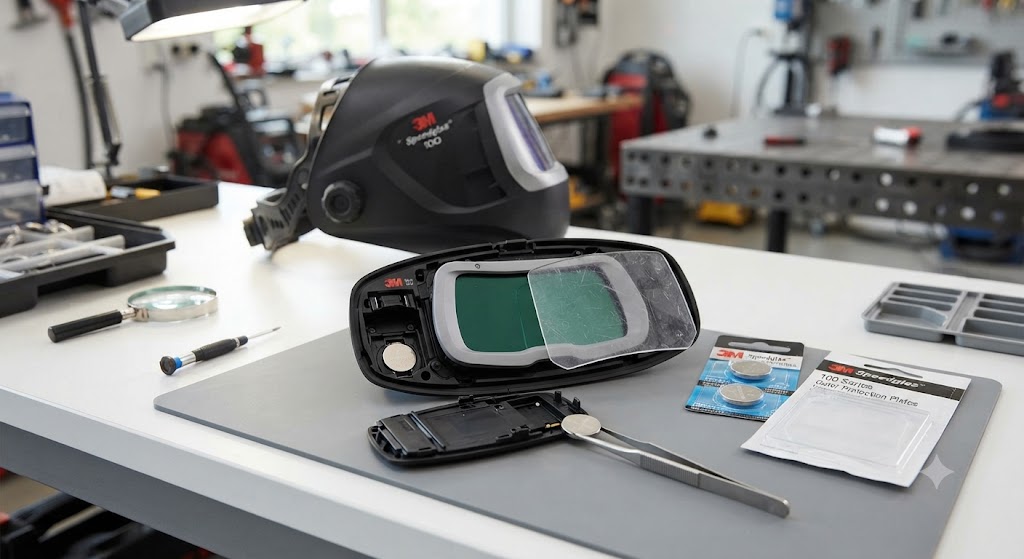
The cover lens is the outer protective plastic sheet that sits in front of the auto darkening filter (ADF). Its entire job is to take the scratches, the spatter, and the arc flash so the ADF underneath stays clear. It is designed to be cheap and replaceable. Most helmets ship with several spares.
The ADF (auto darkening filter) is the electronic lens behind the cover lens. This is the part that actually darkens when you strike an arc. It is the expensive component. It is also the one that people sometimes scratch while trying to clean it.
Most scratches are on the cover lens. This is a minor problem with a simple solution: replace the cover lens. Most cover lenses for popular helmet models cost a few dollars and install without tools in under a minute.
How to tell which lens is scratched
Remove the cover lens and look through the ADF alone. If the ADF is clear, all the scratches were on the cover lens. Replace the cover lens and you are done.
If the scratches persist after removing the cover lens, the ADF itself is scratched. This is a more serious situation.
Fixing a scratched cover lens
For minor surface scratches on a plastic cover lens, a plastic polish or fine rubbing compound applied with a soft cloth can reduce the appearance of the scratches and restore some clarity. Work in small circular motions with light pressure, using a fresh side of the cloth as the compound loads up.
For moderate or deep scratches on a cover lens, skip the polish and replace it. A cover lens costs almost nothing and takes seconds to swap. Trying to sand and polish a heavily scratched cover lens takes time, risks clouding the plastic further, and may not fully restore clarity. The replacement is the better call.
Do not attempt to polish the ADF. The ADF has thin optical coatings on its surfaces that handle UV and infrared filtering. Abrasive polishes, rubbing compounds, and even some cleaning cloths will scratch or remove those coatings. A damaged coating on an ADF is not repairable.
Fixing a scratched ADF
If the ADF itself is scratched, your options are limited.
Light surface marks from dust wiping on a dry cloth sometimes respond to a lens cleaning solution applied with a fresh soft microfiber cloth, wiped in one direction rather than circles. This can reduce the visibility of extremely fine surface haze but will not remove a true scratch.
Deep scratches on an ADF affect optical clarity in ways that matter for welding: the light scattering from a deep scratch can interfere with how you see the arc and the puddle. A significantly scratched ADF should be replaced. Replacement ADFs are available for most popular helmet brands, though they cost more than a cover lens. If the replacement ADF costs close to the cost of a new helmet, the helmet is worth replacing entirely.
What causes welding lens scratches
The most common causes are completely avoidable:
- Wiping with a dry shop rag. Dust particles embedded in a shop rag act like sandpaper on plastic. Always clean the lens with a clean, lint-free cloth and a lens-appropriate cleaner.
- Stacking equipment on the helmet. Tools or other helmets placed on top of yours grind against the lens. Store helmets in a bag or on a hook where nothing rests on the lens.
- Grind spatter without a cover lens. Many welders forget to replace the cover lens after switching from welding to grinding. Grinding generates fine metal particles that embed in the ADF surface rapidly.
- Dropping the helmet face-down. A helmet dropped face-down onto concrete or grating scratches the lens immediately.
When to replace instead of repair
Replace the cover lens any time it is visibly scratched. Cover lenses are consumables, not permanent components. Replacing them regularly, before scratches affect your view, is part of basic helmet maintenance.
Replace the ADF when:
- Scratches on the ADF affect your ability to see the puddle clearly.
- The ADF has been wiped with an abrasive and the coatings are damaged or cloudy.
- The ADF is old enough that the clarity has deteriorated on its own.
A clear view of the puddle is a safety issue and a quality issue. You cannot put a clean bead where you cannot see one.
Frequently asked questions
Can a scratched welding helmet lens be safely repaired? The cover lens can be polished for minor scratches or replaced for moderate to severe scratches. The ADF should not be polished. A heavily scratched ADF should be replaced.
When should you replace the lens instead of cleaning it? Replace the cover lens whenever scratches are visible enough to affect your view or when the lens is heavily spattered. Replace the ADF when scratches or coating damage persists after cover lens replacement and affects clarity.
What causes welding lenses to scratch so easily? The cover lens is soft plastic, designed to absorb damage instead of the more expensive ADF. Dry wiping, dust-contaminated cloths, grind spatter, and storing the helmet face-down are the most common causes.
Can I weld with a scratched lens? For minor scratches off to the side of your direct view, it may not be immediately dangerous, but it increases eye strain and reduces your ability to see the puddle clearly. Replace or repair before it affects your weld quality or your ability to respond to a changing weld pool.
Are replacement cover lenses universal? No. Cover lenses are specific to the helmet model or lens size. Check your helmet’s model number before ordering. Most popular helmets have readily available cover lens packs, often sold in quantities of five to ten.
How do you clean a welding lens without scratching it? Use a clean, lint-free microfiber cloth slightly dampened with a lens cleaning solution or plain water. Wipe gently in one direction or in light circles using only the weight of the cloth, not pressure. Never use a dry shop rag, paper towel, or any abrasive cleaner on the lens.
References
- American National Standards Institute (ANSI) Z87.1, eye and face protection standard
- Occupational Safety and Health Administration (OSHA), eye protection for welding
- Lincoln Electric, welding helmet maintenance and lens care guidelines
- American Welding Society (AWS), welding safety and PPE practices