A Practical Look at Airgas Welding Supply: Flow Rates, Troubleshooting and Safety
Sooner or later, every gas welder has to answer a practical question that has nothing to do with technique: where does the gas actually come from, and how do I keep it flowing. Airgas is one of the largest gas and welding supply companies in the United States, with branches across the country, and for many welders it is the answer to that question. Understanding how to work with a supplier like this, and how to set up what you bring home, saves money and frustration.
This guide is about the practical side of sourcing and using shielding gas, using Airgas as a familiar example of a full service supplier. The principles apply whether you buy from a national chain or a local gas house.
Owning versus leasing a cylinder
The first decision at any gas supplier is whether you own your cylinder or use theirs. Suppliers like Airgas typically offer both owned cylinders and lease or exchange programs, and the difference matters over time.
With an exchange program, you swap your empty for a full one and never worry about the cylinder’s certification or condition, since that stays with the supplier. With an owned cylinder, you are responsible for keeping it within its hydrostatic test date, but you always get your own bottle back. For an occasional hobbyist, exchange is usually simpler. For someone who uses gas steadily, owning can work out better. Ask the branch directly which programs they run, because the details vary by location.
Choosing the right gas and cylinder size
A supplier will carry the full range: pure CO2 and 75/25 argon and CO2 mixes for steel, pure argon for aluminum and TIG, and specialty blends. Match the gas to your metal, as covered in any MIG setup guide, and match the cylinder size to how much you weld.
A small cylinder is easy to carry and store but needs refilling often. A large cylinder costs more up front and takes more space, but the gas is cheaper per unit and you refill far less. If you weld regularly, a bigger bottle usually pays for itself in fewer trips and a lower cost per cubic foot.
Setting flow rate at home
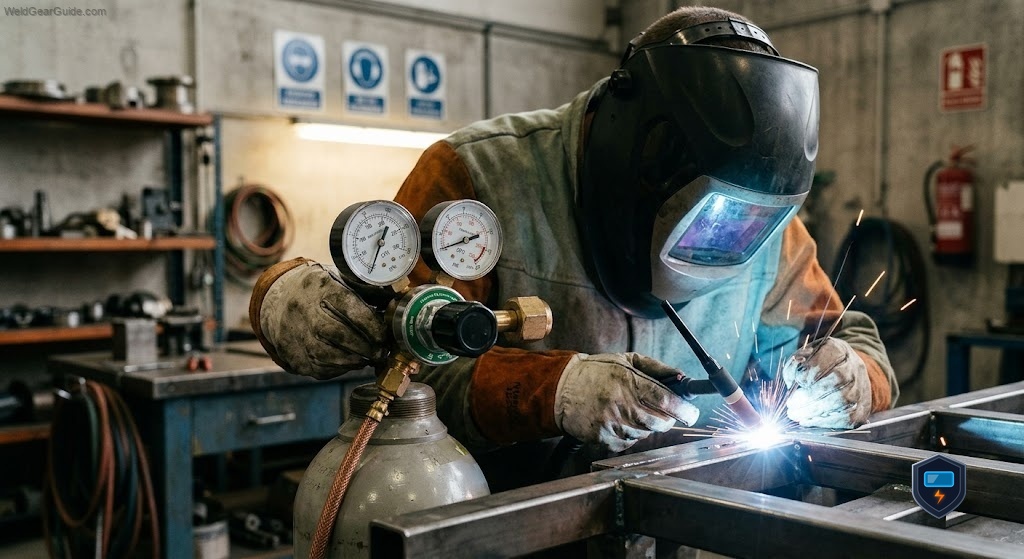
What you bring home is only useful with a good regulator and a sensible flow. Mount a flowmeter regulator such as the RX WELD argon and CO2 regulator on the cylinder, matched to the CGA-580 inlet on argon and mixed gas bottles, and set a moderate flow, commonly around 20 to 30 CFH for indoor steel MIG. The honest note on budget regulators is that the flow ball can read a little off, so let a clean test bead confirm the setting.
Resist the urge to run high flow. Turbulent gas pulls air into the shield and causes porosity, and it drains an expensive cylinder fast.
Troubleshooting common gas problems
- Porosity in the weld. Usually a draft, a leak, or a clogged nozzle rather than too little gas. Block drafts, soapy water test the fittings, and clean the nozzle.
- Gas runs out too fast. Check for leaks first, then confirm you are not running an unnecessarily high flow. A hissing fitting empties a bottle quietly.
- Regulator gauge does not move. Make sure the cylinder valve is fully open and the regulator is seated on the correct inlet for that gas.
- Frost on a CO2 regulator. Some chilling is normal with CO2 at high flow, but heavy icing suggests the flow is too high or the setup needs a heater for that gas.
Cylinder safety at home
A compressed gas cylinder is safe when handled correctly and dangerous when it is not.
Secure every cylinder upright with a chain or strap to a cart, bench, or wall. A tipped bottle can shear its valve and turn into a hazard. Keep the protective cap on when the regulator is off, never move a bottle with the regulator attached, and store cylinders away from heat and out of enclosed living spaces. Open the valve slowly so the regulator is not slammed with sudden pressure.
Final read
Working with a welding gas supplier is mostly about a few practical choices: own or exchange your cylinder, size the bottle to your usage, and set a moderate flow with a good regulator at home. Handle the cylinder safely, troubleshoot porosity at its real causes rather than by adding gas, and the supply side of gas welding becomes routine instead of a recurring headache.
Frequently asked questions
Should I own or exchange my gas cylinder? Exchange is simpler for occasional users, since the supplier handles certification. Owning suits steady users who want their own bottle back. Ask your branch which programs they offer.
What cylinder size should I get? Small bottles are portable but need frequent refills. Larger bottles cost more up front but are cheaper per unit and mean fewer trips. Size it to how much you weld.
What flow rate should I set? Around 20 to 30 CFH for indoor steel MIG. Avoid high flow, which turns turbulent, causes porosity, and wastes gas.
Why does my cylinder empty so quickly? Often a leak or an unnecessarily high flow rate. Soapy water test the fittings and set a moderate flow before assuming the bottle was underfilled.
How do I store a gas cylinder safely? Upright, secured with a chain or strap, cap on when not in use, away from heat and enclosed living spaces. Never move it with the regulator attached.
Can I refill any cylinder anywhere? Suppliers usually exchange or refill within their own programs and require cylinders to be within test date. Confirm the specifics with the branch you use.
References
- OSHA 1910.253, Oxygen fuel gas welding and cutting: https://www.osha.gov/laws-regs/regulations/standardnumber/1910/1910.253
- OSHA, Welding, Cutting, and Brazing: https://www.osha.gov/welding-cutting-brazing
- National Institute for Occupational Safety and Health, Welding safety: https://www.cdc.gov/niosh/welding/about/index.html