Argon Gas Welder Explained: How to Set Flow Without Wasting Gas
Watch a skilled TIG welder work and the weld looks almost effortless: a bright, controlled puddle laying down a row of stacked, silvery beads. A big part of what makes that possible is invisible. It is argon, the inert gas flowing quietly over the weld and keeping the air away. Get the argon right and clean welds get easier. Get it wrong and even good technique fights porosity and discoloration.
An argon gas welder, in everyday terms, is any welding setup that uses argon as its shielding gas, most often a TIG machine and often MIG on aluminum. Argon is inert, meaning it does not react with the weld, so it forms a clean protective blanket over the molten metal. That purity is exactly why it is the gas of choice for the metals and processes that demand a spotless weld.
Why argon, and where it is needed
Argon shields the weld pool completely because it does not participate in the reaction the way an active gas would. For TIG welding it is the standard shielding gas across steel, stainless, and aluminum. For MIG on aluminum, pure argon is required, since the argon and CO2 mixes used for steel will not shield aluminum properly.
The key mental note is that argon is a premium gas and you use it where cleanliness matters most. That also means wasting it is more expensive than wasting a cheaper steel mix, which makes flow control worth getting right.
Setting argon flow without waste
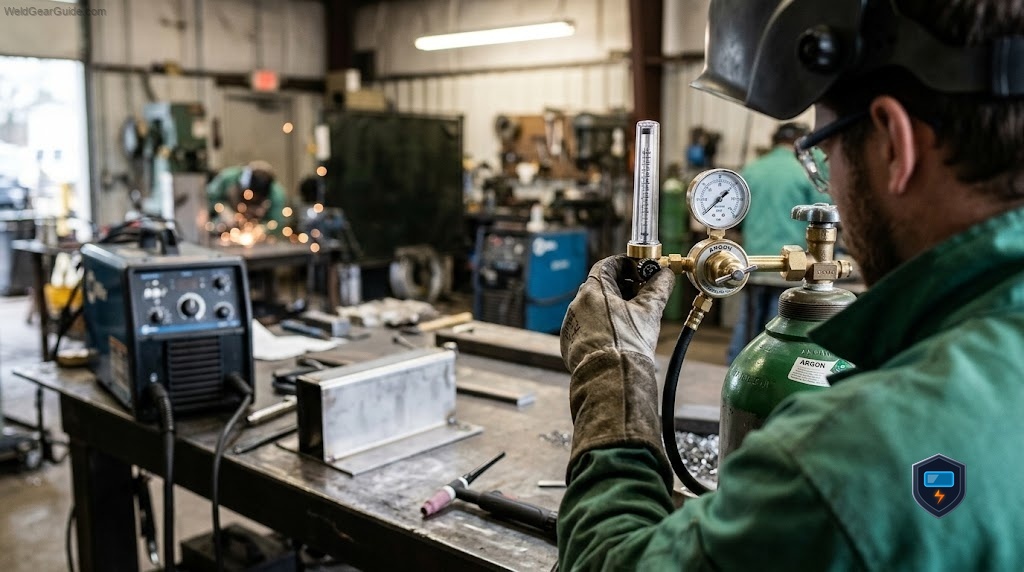
Argon flow, like all shielding gas, is measured in cubic feet per hour. The temptation to run it high for extra protection backfires. Too much flow becomes turbulent and drags surrounding air into the shield, which causes the porosity and the dull, discolored weld you were trying to avoid, while draining the cylinder quickly.
For most TIG work, a flow in the range of roughly 15 to 20 CFH shields the puddle well, with the exact number depending on the torch cup size and the joint. Start moderate, run a bead, and read it. A bright, clean weld means your coverage is right. Discoloration or porosity at a sensible flow usually points to a draft, a leak, or too small a cup rather than too little gas.
Habits that stretch a bottle:
- Block drafts. Argon is easily blown off the puddle by a fan or open door. Fix the draft rather than raising the flow.
- Mind the post flow. Gas that keeps flowing after the arc stops protects the cooling weld and the tungsten. That is intended, not waste.
- Match the cup to the flow. A larger cup shields a wider area and can run efficiently. Cranking flow through a tiny cup just creates turbulence.
- Leak check the line. A hissing fitting empties an expensive bottle quietly.
The regulator and machine
Control argon with a flowmeter regulator sized to the CGA-580 inlet on argon cylinders. A unit like the ATPEAM argon regulator flowmeter or the RX WELD argon flowmeter regulator gives a clear flow reading so you can set it deliberately. The honest note on budget regulators is that the flow indicator can read slightly off, so trust a clean test bead over the exact figure.
For the machine, a DC TIG capable unit like the ARCCAPTAIN 200A stick and lift TIG welder or the precise Miller Maxstar 161 S runs argon for steel and stainless TIG. Note that welding aluminum by TIG generally needs an AC capable machine, which many budget DC units are not, so match the machine to the metal before you count on it for aluminum.
Final read
An argon gas welder makes clean welds when the shield is set with care. Run a moderate flow rather than a high one, match the cup to the job, and fix drafts and leaks instead of drowning them in gas. Because argon is a premium gas, that discipline both improves the weld and keeps a costly cylinder lasting far longer.
Frequently asked questions
What flow rate should I use for TIG with argon? Roughly 15 to 20 CFH for most work, adjusted for cup size and joint. Start moderate and confirm with a clean test bead rather than running it high.
Why argon instead of a CO2 mix for TIG? Argon is inert and forms a clean protective blanket over the weld. TIG demands that cleanliness, and aluminum MIG requires pure argon as well.
Does higher argon flow protect better? No. Excess flow turns turbulent and pulls in air, causing porosity and discoloration while wasting expensive gas. Moderate, steady flow shields best.
Can I weld aluminum with any argon TIG machine? Aluminum TIG generally needs an AC capable machine. Many budget DC only units cannot do it, so check the machine before relying on it for aluminum.
Why is my TIG weld discolored? Often a draft, a leak, too small a cup, or the tungsten cooling without post flow. Check shielding coverage before assuming a flow problem.
How do I make an argon bottle last? Set a moderate flow, block drafts, leak check the fittings, and match the cup to the job. Most waste comes from high flow used to fight problems with other fixes.
References
- OSHA, Welding, Cutting, and Brazing: https://www.osha.gov/welding-cutting-brazing
- National Institute for Occupational Safety and Health, Welding safety: https://www.cdc.gov/niosh/welding/about/index.html
- American Welding Society, standards and codes: https://www.aws.org/standards-and-publications/codes-and-standards/d1-1/