AWS Weld Symbol Standards Explained
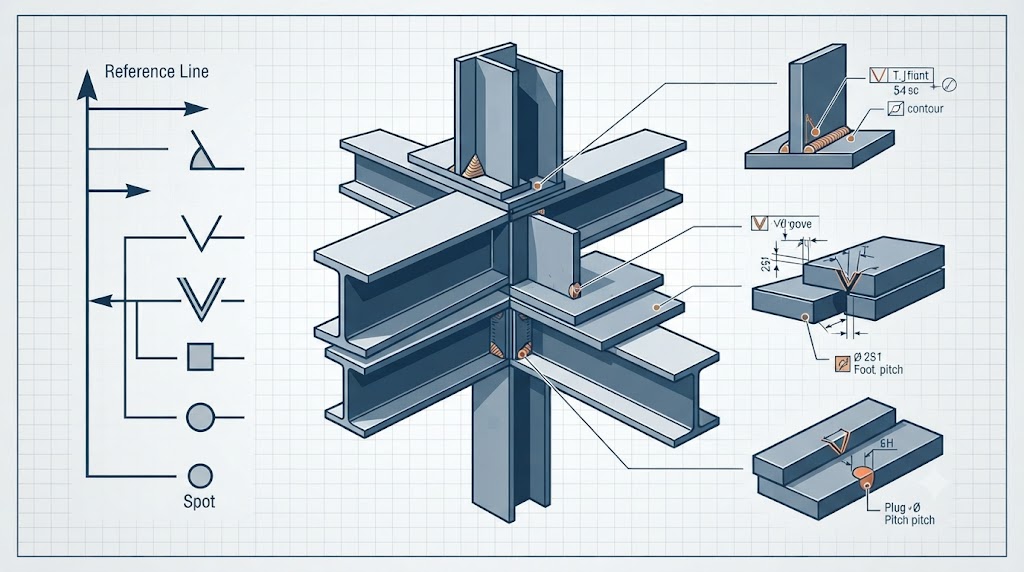
Every little triangle, flag, and number on a welding print traces back to one rulebook. In North America, that rulebook is AWS A2.4, the standard that decides exactly what each weld symbol means and how it is drawn. Knowing the standard behind the symbols is what lets a welder in Texas read a drawing made in Ohio and build the right weld. This guide explains the AWS weld symbol standard, how it differs from the international ISO system, and where to get an official chart.
AWS A2.4 is the American Welding Society standard that defines welding, brazing, and nondestructive examination symbols. Published as ANSI/AWS A2.4, it sets the rules for how weld symbols are drawn and interpreted. Here is what it covers and how it compares to ISO 2553.
What the AWS standard covers
AWS A2.4 governs the whole symbol system:
- The elements, including the reference line, arrow, weld symbols, and tail.
- Placement rules, such as arrow side below the reference line and other side above it.
- Dimensions, how size, length, and spacing are shown for each weld type.
- Supplementary symbols, like weld-all-around and field-weld marks.
- Nondestructive examination symbols, for inspection callouts.
Because the standard defines all of this, a symbol drawn to AWS A2.4 means the same thing on any drawing that follows it.
Direct answer: what is the AWS standard for weld symbols?
Here are the essentials:
- The standard is AWS A2.4, titled Standard Symbols for Welding, Brazing, and Nondestructive Examination.
- It is issued as ANSI/AWS A2.4, carrying American National Standards Institute recognition.
- It uses a single reference line, with arrow-side welds below and other-side welds above.
- It is updated periodically, so different editions differ in detail.
- The official version comes from AWS, the American Welding Society.
When a drawing’s notes cite AWS A2.4, those are the rules the symbols follow.
The single reference line system
The defining feature of the AWS system is the single, solid reference line. Everything reads off that one line: a weld symbol placed below it means the weld goes on the arrow side (the side the arrow points to), and a weld symbol placed above it means the other side. Symbols both below and above mean both sides. Dimensions attach to the weld symbol in fixed spots, such as fillet leg size to the left and length to the right. Supplementary marks sit at the junction where the arrow meets the reference line, and the tail at the far end holds process or specification notes. This one-line approach is simple once learned, and it is the core of how AWS A2.4 organizes information.
AWS versus ISO 2553
Internationally, many drawings follow ISO 2553 instead of AWS A2.4, and the differences matter. The biggest one is the reference line. AWS uses a single solid line, with arrow side below and other side above. ISO 2553 System A uses two lines, a solid line and a dashed line: the arrow-side weld sits on the solid line and the other-side weld sits on the dashed line, regardless of which is drawn on top. Fillet sizing also differs: AWS commonly gives the leg length, while ISO uses a throat thickness (with an “a” prefix) or leg length (with a “z” prefix). And the tail notes differ: AWS uses process letter abbreviations like GMAW or SMAW, while ISO uses numeric process codes from ISO 4063, such as 135 or 111. Because the two systems can look similar but mean different things, you should always know which standard a drawing follows before reading its symbols.
Where to get an official chart
A common question is where to find an authoritative symbol chart. The official source is the American Welding Society, which publishes the AWS A2.4 standard itself, the definitive reference containing every symbol and rule. Many manufacturers and educators also publish simplified reference charts that summarize the common symbols for quick shop use, and those are handy for day-to-day work. The important point is that quick charts are summaries, while the standard is the authority: when a real question comes up about exactly how a symbol should be drawn or interpreted, the AWS A2.4 document is what settles it. For code and contract work, the cited edition of the standard is what governs.
The bottom line
AWS A2.4 is the standard behind every weld symbol on a North American print, defining the reference line, arrow, weld symbols, dimensions, supplementary marks, and inspection callouts. Its single-reference-line system puts arrow-side welds below the line and other-side welds above it, a simple structure once you know it. Internationally, ISO 2553 covers the same ground differently, using two reference lines and numeric process codes, so always confirm which standard a drawing follows. And when precision matters, remember that quick charts are summaries while the AWS A2.4 document itself, published by the American Welding Society, is the authority.
FAQ
What is the AWS standard for weld symbols? It is AWS A2.4, titled Standard Symbols for Welding, Brazing, and Nondestructive Examination, issued as ANSI/AWS A2.4. It defines how every weld symbol is drawn and interpreted, including the reference line, arrow, weld symbols, dimensions, and supplementary marks, so symbols mean the same thing on any drawing that follows it.
Is AWS A2.4 the same as ISO weld symbols? No. AWS A2.4 and ISO 2553 are different standards. The main difference is the reference line: AWS uses a single solid line with arrow side below and other side above, while ISO 2553 System A uses a solid line and a dashed line. They also differ in fillet sizing and in how the tail notes the welding process.
Where can I get an official AWS symbol chart? The authoritative source is the American Welding Society, which publishes the AWS A2.4 standard containing every symbol and rule. Manufacturers and schools also publish simplified quick-reference charts for shop use, but those are summaries; the AWS A2.4 document itself is the definitive reference.
Does AWS put arrow-side welds above or below the line? Below. In the AWS system, a weld symbol below the reference line means the weld goes on the arrow side, and a weld symbol above the reference line means the other side. Symbols both below and above mean both sides. This single-line rule is central to AWS A2.4.
What does ANSI AWS A2.4 mean? It means the AWS A2.4 standard is also recognized by the American National Standards Institute, so it is written as ANSI/AWS A2.4. The ANSI designation reflects that it is an American National Standard, giving it broad recognition across industry and codes in the United States.
How does AWS note the welding process on a symbol? AWS uses letter abbreviations for the process in the tail of the symbol, such as GMAW for gas metal arc welding or SMAW for shielded metal arc welding. This differs from ISO 2553, which uses numeric process codes from ISO 4063, such as 135 or 111, for the same information.
References
- AWS A2.4, Standard Symbols for Welding, Brazing, and Nondestructive Examination (industry standard), aws.org.
- Miller Electric guide to reading and understanding weld symbols (manufacturer), millerwelds.com.
- Comparisons of AWS A2.4 and ISO 2553 weld symbol systems (industry references), aws.org.