Butt Weld Symbol Guide
Two pieces of plate or pipe meeting end to end, in the same plane, form a butt joint, and it is one of the most fundamental joints in fabrication. But here is the catch that confuses many people: there is no single “butt weld symbol.” A butt joint is welded with a groove weld, so the symbol you use is the groove symbol. This guide clears up the butt joint versus butt weld confusion and shows exactly how to symbolize the welds you make in a butt joint.
A butt weld joins two members in the same plane, edge to edge, and it is symbolized using a groove weld symbol (square, V, bevel, U, or J) that shows how the edges are prepared. There is no separate butt symbol. Here is how to read and use it.
Butt joint versus butt weld
The terms cause endless confusion, so start here:
- A butt joint is the joint configuration: two members in the same plane meeting edge to edge.
- A butt weld is the weld made in that joint, which is a groove weld.
- The symbol used is therefore the groove weld symbol, not a unique “butt” symbol.
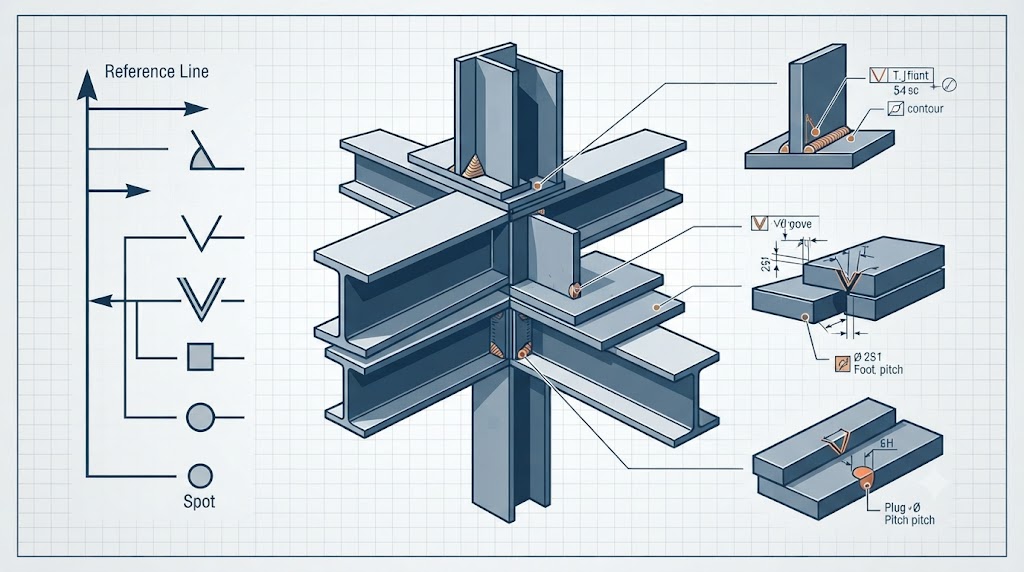
- The groove shape (square, V, bevel, U, J) tells you how the edges are prepared.
So when a drawing calls for a butt weld, look for a groove symbol on the reference line.
Direct answer: how to symbolize a butt weld
To read or specify a butt weld, do the following:
- Recognize the butt joint, two members meeting in the same plane, edge to edge.
- Use the groove symbol matching the edge preparation (square, V, bevel, U, or J).
- Apply the position rule: below the reference line for arrow side, above for other side.
- Read the groove angle and root opening for the joint fit-up.
- Check the size and penetration: no size on a single groove generally means complete penetration.
The whole trick is knowing that “butt weld” points you to the groove weld symbol.
Why there is no separate butt symbol
It helps to understand the logic. Welding symbols describe the weld, not the joint. The joint (butt, T, lap, corner, edge) is shown by the geometry of the drawing, while the symbol tells you what weld to make in it. Because a butt joint is almost always welded with a groove weld, the groove symbol does the job, and there is no need for a redundant “butt weld” mark. The same groove symbols you would use elsewhere apply directly: a square groove for thin butt joints, a V-groove for a common full-penetration butt weld, and so on. Once you internalize that symbols describe welds and drawings show joints, the absence of a butt symbol makes complete sense.
Choosing the groove for a butt joint
Which groove symbol goes on a butt joint depends on thickness and penetration needs. For thin material, a square groove (parallel lines) works, since the edges need little or no preparation. For thicker material that needs full penetration, a V-groove is the classic choice, with both edges beveled to open up access to the root. A single-bevel groove prepares only one edge, a U-groove saves weld metal on heavy sections with a curved preparation, and a J-groove is the one-sided curved version. So specifying a butt weld really means choosing the right groove preparation for the plate or pipe thickness and the required strength, then drawing that groove symbol on the reference line.
Penetration in butt welds
Penetration is often the whole point of a butt weld, so it deserves attention. A complete joint penetration (CJP) butt weld fuses through the entire thickness of the joint, giving full-strength continuity between the members, and for a single groove with no size specified, complete penetration is generally implied. A partial joint penetration (PJP) butt weld fuses only part of the thickness, and its depth (effective throat) is stated, often in parentheses. On pressure work and structural joints, CJP butt welds are common because the joint must be as strong as the base metal. Reading the size (or the absence of one) and any parenthetical throat on the groove symbol tells you whether the butt weld is full or partial penetration, which is critical information.
The bottom line
The key to butt welds is dropping the search for a “butt weld symbol,” because there is not one. A butt joint (two members meeting edge to edge in the same plane) is welded with a groove weld, so you use the groove symbol, square, V, bevel, U, or J, that matches the edge preparation. Apply the usual position rule for arrow side and other side, read the groove angle and root opening for fit-up, and pay close attention to penetration: a single groove with no size generally means complete joint penetration, while a stated depth means partial. Understand that symbols describe welds and the drawing shows the joint, and butt welds stop being confusing.
FAQ
Is there a separate butt weld symbol? No. There is no unique butt weld symbol. A butt joint is welded with a groove weld, so you use the groove weld symbol (square, V, bevel, U, or J) that matches the edge preparation. Welding symbols describe the weld, while the drawing geometry shows that it is a butt joint.
What is the difference between a butt joint and a butt weld? A butt joint is the configuration, two members in the same plane meeting edge to edge. A butt weld is the weld made in that joint, which is a groove weld. So the joint is the arrangement of the parts, and the weld (symbolized by a groove symbol) is what joins them.
Which groove symbol is used for a butt weld? It depends on thickness and penetration needs: a square groove for thin material, a V-groove for common full-penetration butt welds, a single-bevel groove for one prepared edge, and U or J grooves for thicker sections. You choose the groove preparation that suits the plate or pipe, then draw that symbol.
How do you show full penetration on a butt weld? For a single groove weld with no size specified, complete joint penetration is generally implied. You can also note CJP requirements explicitly. A partial joint penetration weld instead has its depth (effective throat) stated, often in parentheses, so the presence or absence of a size tells you the penetration.
Do butt welds need edge preparation? Often yes. Thin butt joints may use a square groove with little preparation, but thicker joints needing full penetration are usually beveled into a V, U, or J groove to open access to the root. The groove symbol on the drawing tells you exactly what edge preparation the butt weld requires.
Why are butt welds common on pressure and structural work? Because a complete joint penetration butt weld fuses through the full thickness, making the joint as strong as the base metal, which pressure and structural joints require. The groove symbol, and whether a size is specified, communicates that full-penetration requirement to the welder.
References
- AWS A2.4, Standard Symbols for Welding, Brazing, and Nondestructive Examination, groove weld provisions (industry standard), aws.org.
- Miller Electric and Lincoln Electric guides to groove and butt joint weld symbols (manufacturers), millerwelds.com, lincolnelectric.com.
- The National Board references on complete and partial joint penetration in butt joints (industry reference), nationalboard.org.