Fillet Weld Symbol Explained
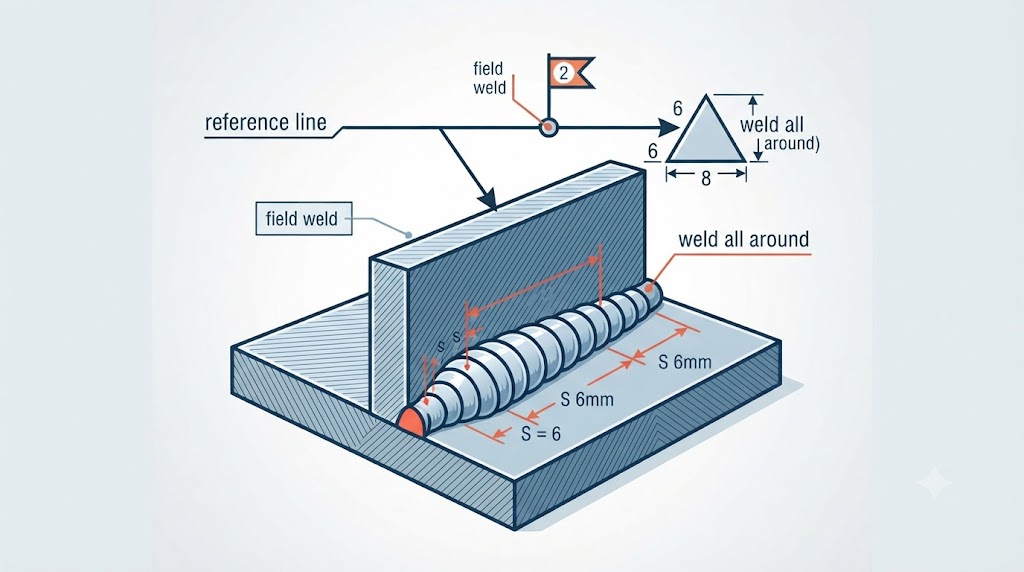
The fillet weld is the workhorse of the trade, the weld you make at nearly every T-joint, lap, and corner, so its symbol is the one you will read most often on a drawing. Get comfortable with the little right triangle and the numbers around it and you can read a huge share of everyday blueprints. This guide explains the fillet weld symbol piece by piece: the triangle, which side it goes on, how size and length are shown, and how to read unequal legs.
The fillet weld symbol is a right triangle placed on the reference line, with the vertical leg always drawn on the left. Its size is placed to the left of the triangle and its length to the right, and its position (below or above the reference line) tells you which side to weld. Here is the full explanation.
What a fillet weld is
Before the symbol, the weld itself:
- A triangular weld joining two surfaces roughly at right angles.
- Used at T-joints, lap joints, and corner joints, the most common joint types.
- No joint preparation needed in most cases, unlike groove welds.
- Defined by its leg size, the length of each side of the triangular cross-section.
Because fillet welds are so common, their symbol is the first one most welders truly learn.
Direct answer: reading the fillet symbol
To read a fillet weld symbol, check these in order:
- The triangle on the reference line tells you it is a fillet weld.
- Its position: below the reference line means arrow side, above means other side.
- The number to the left of the triangle is the leg size.
- The number to the right is the weld length.
- A triangle on both sides of the reference line means weld both sides.
The triangle’s vertical leg is always drawn on the left, a fixed convention that never changes.
The triangle and its orientation
Start with the shape itself. The fillet weld symbol is a right triangle, and by convention the perpendicular (vertical) leg is always drawn on the left side of the symbol, with the sloping side to the right, no matter which way the actual weld faces on the part. This is a fixed drawing rule, so do not read anything into the triangle’s orientation about the physical weld direction. The triangle sits on the reference line, and its position relative to that line, below or above, is what tells you where the weld goes. That fixed-left convention is worth memorizing, because it is a common point of confusion for people new to reading symbols.
Arrow side, other side, and both sides
As with all welding symbols, position carries the meaning. A fillet triangle drawn below the reference line means the weld is made on the arrow side, the side the arrow points to. A triangle drawn above the reference line means the weld is on the other side. When the symbol shows a triangle both below and above the reference line, you make a fillet weld on both sides of the joint, a very common instruction for T-joints that need strength from both faces. If only one triangle appears, only that one side is welded. This below/above/both logic is identical across weld types, so once you have it for fillets you have it everywhere.
Size and length
Now the numbers. The leg size of the fillet is placed to the left of the triangle, on the same side of the reference line as the symbol, telling you how big each leg of the triangular weld should be. The length of the weld is placed to the right of the triangle. If no length is shown, the weld typically runs the full length of the joint. So a symbol reading, from left to right, size then triangle then length, tells you a fillet of that leg size, run for that length, on the side the triangle’s position indicates. When the weld is intermittent rather than continuous, the length is paired with a spacing (pitch) figure, which is covered in the guide to stitch and tack welds.
Unequal leg fillets
Most fillets have equal legs, but sometimes a design calls for a fillet with legs of two different sizes. In that case, both leg dimensions are shown to the left of the triangle, separated by a multiplication sign (for example, two numbers with an “x” between them). Because the order of the two numbers does not itself tell you which leg is which, the drawing shows the orientation of the unequal legs on the joint view, so you match the larger and smaller leg to the correct members. If you see two dimensions with an “x” by a fillet triangle, that is the sign of an unequal-leg fillet, and you should check the drawing view to see which way it goes.
The bottom line
The fillet weld symbol is the one you will read most, so it pays to know it cold. It is a right triangle with the vertical leg always on the left, sitting on the reference line. Position tells you the side: below for arrow side, above for the other side, both for both sides. The leg size goes to the left of the triangle and the length to the right, and unequal legs are shown as two numbers separated by an “x” with the orientation clarified on the drawing. Master this one symbol and you can read the joints on a huge share of everyday welding prints.
FAQ
What does the fillet weld symbol look like? It is a right triangle placed on the reference line, with the perpendicular (vertical) leg always drawn on the left by convention. The triangle identifies the weld as a fillet, used at T-joints, lap joints, and corner joints. Its position relative to the reference line tells you which side of the joint to weld.
Which side of the reference line is the fillet triangle? It depends on which side to weld. A triangle below the reference line means the arrow side, a triangle above means the other side, and triangles both below and above mean weld both sides. This position rule is the same across all welding symbols, not just fillets.
Where does the fillet weld size go on the symbol? The leg size is placed to the left of the triangle, on the same side of the reference line as the symbol. The weld length, if specified, goes to the right of the triangle. So reading left to right you get the size, then the triangle, then the length.
How are unequal fillet legs shown? Both leg dimensions are placed to the left of the triangle, separated by a multiplication sign. Because the order does not itself indicate which leg is which, the drawing shows the orientation of the unequal legs on the joint view, so you match the larger and smaller legs to the correct members.
What does a fillet symbol on both sides mean? A fillet triangle drawn both below and above the reference line means you make a fillet weld on both sides of the joint. This is common for T-joints needing strength from both faces. A single triangle means only that one side, arrow or other, is welded.
Why is the fillet triangle’s vertical leg always on the left? It is a fixed drawing convention in the welding symbol standard, so the perpendicular leg is drawn on the left regardless of how the actual weld faces on the part. It does not indicate the physical direction of the weld, so read the triangle’s position, not its shape, for meaning.
References
- AWS A2.4, Standard Symbols for Welding, Brazing, and Nondestructive Examination, fillet weld symbol provisions (industry standard), aws.org.
- Miller Electric and Lincoln Electric guides to reading fillet weld symbols (manufacturers), millerwelds.com, lincolnelectric.com.
- AWS A3.0 terms and definitions for fillet welds (industry standard), aws.org.