Plug and Slot Weld Symbol Guide
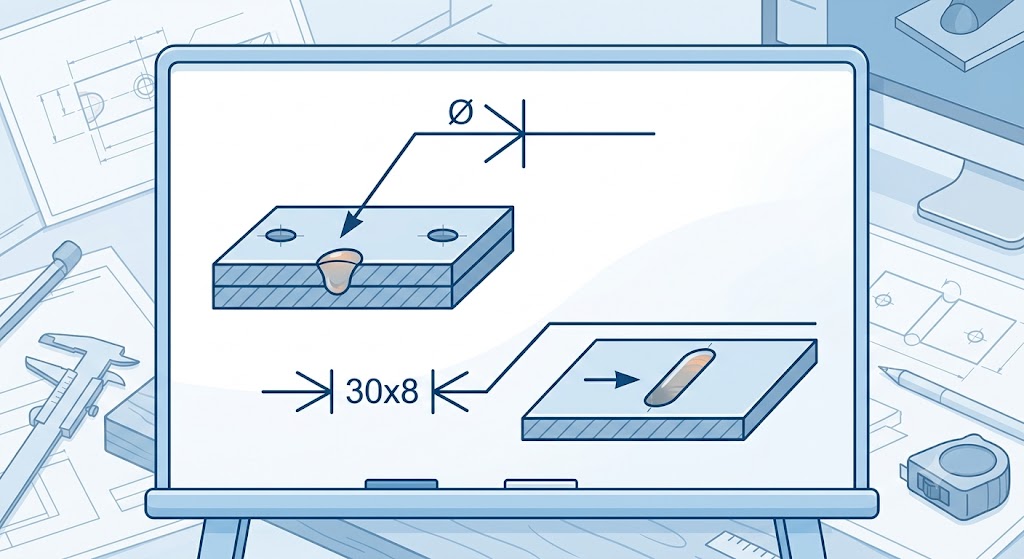
Sometimes you need to join two overlapping plates where you cannot reach the edges, so instead of welding around the outside, you drill a hole through the top plate and fill it with weld metal, fusing the two together from the middle. That is a plug weld, and its stretched-out cousin is a slot weld. They have their own symbols with their own dimensions, and they trip people up because the numbers mean different things than on a fillet. This guide explains the plug and slot weld symbols clearly.
A plug weld symbol represents a weld filling a round hole in one member to join it to another, while a slot weld fills an elongated hole. The symbol carries the hole size, spacing, countersink angle, and depth of filling. Here is how to read both.
What plug and slot welds are
These welds join overlapping members through holes rather than at edges:
- Plug weld: a round hole in the top member, filled with weld to fuse it to the member below.
- Slot weld: the same idea, but the hole is elongated (a slot) rather than round.
- Used on lap joints where edge access is limited or extra shear strength is needed.
- Filled fully or partially, depending on the design.
Both are essentially holes filled with weld metal, and their symbols describe the hole and the fill.
Direct answer: reading the symbol
To read a plug or slot weld symbol, check these:
- The symbol type tells you plug (round) or slot (elongated) weld.
- Position: below the reference line means the hole is on the arrow side, above means the other side.
- The size to the left is the hole diameter (plug) or width (slot).
- The countersink angle is shown if the hole is countersunk.
- The depth of filling is shown inside the symbol if it is less than complete.
- The pitch to the right is the center-to-center spacing of multiple welds.
The key mental shift is that the size refers to the hole, not to a weld leg.
Plug versus slot
The difference between the two is simply the shape of the hole. A plug weld fills a round hole, and a slot weld fills an elongated hole or slot, but they work the same way: the hole passes through the arrow-side member, and weld metal fills it to fuse that member to the one beneath. You choose a slot over a plug when you need more weld area (and therefore more shear strength) than a round hole provides, or when the geometry suits a slot. On the symbol, the placement rules are the same as any weld: the symbol below the reference line means the holes are in the arrow-side member, above means the other-side member. The main thing to keep straight is that these symbols describe holes to be made and filled, which is a different mindset than a fillet or groove.
The dimensions
Here is where plug and slot symbols carry their own specific numbers. The size to the left of the symbol is the diameter of the hole (for a plug) at its root, telling you how big to make the hole. If the hole is countersunk (angled wider at the top), the included angle of that countersink is shown with the symbol. The depth of filling is important: by default the hole is filled completely, but if the design calls for a partial fill, that depth is shown inside the symbol, so a number inside means fill only to that depth rather than flush. Finally, when there are multiple plug welds in a row, the pitch, the center-to-center spacing between them, is placed to the right of the symbol. For slot welds, the length, width, spacing, and orientation of the slots are typically detailed on the drawing because a slot has more geometry than a round hole.
Depth of filling explained
The depth-of-filling rule catches people out, so it is worth isolating. When no depth is given inside the plug or slot symbol, the hole is meant to be filled completely, flush with the surface of the member. When a number appears inside the symbol, that number is the depth to fill, meaning the weld metal only comes up to that depth in the hole, not all the way. This lets a designer call for a partial fill where a complete fill is not needed. So the presence or absence of a number inside the symbol is the quick tell: nothing inside means fill it up completely, a number inside means fill only to that stated depth.
The bottom line
Plug and slot welds join overlapping members by filling a hole with weld metal, and their symbols describe that hole and its fill. A plug weld fills a round hole, a slot weld fills an elongated one, and both follow the standard rule that below the reference line means the arrow-side member and above means the other side. Read the size to the left as the hole diameter or width, look for a countersink angle if the hole is countersunk, and check inside the symbol for a depth of filling, where a number means a partial fill and nothing means fill completely. Spacing between multiple welds is the pitch, placed to the right. Once you think of these as holes to fill rather than edge welds, the symbols read naturally.
FAQ
What is the difference between a plug and slot weld? Both fill a hole in the arrow-side member with weld metal to join it to the member beneath, but a plug weld fills a round hole while a slot weld fills an elongated hole or slot. A slot is chosen when more weld area and shear strength are needed than a round hole provides, or when the geometry suits it.
What does the size mean on a plug weld symbol? The size to the left of the symbol is the diameter of the hole at its root, telling you how big to make the hole. This is a key mental shift from fillet symbols: the number describes the hole to be made and filled, not a weld leg length.
How is depth of filling shown on a plug weld? By default, with no number inside the symbol, the hole is filled completely, flush with the surface. If a number appears inside the symbol, that is the depth to fill, meaning weld metal comes up only to that depth rather than all the way. So a number inside means a partial fill.
What does the countersink angle on a plug weld mean? If the hole is countersunk, that is, angled wider at the top, the included angle of the countersink is shown with the symbol. This tells the fabricator to prepare the hole with that angled opening before filling it, which can help the weld fuse and tie in at the surface.
How is spacing shown for multiple plug welds? The pitch, the center-to-center distance between adjacent plug welds, is placed to the right of the symbol. This tells you how far apart to space a row of plug welds. For slot welds, the length, width, spacing, and orientation are usually detailed on the drawing because a slot has more geometry.
Which side gets the hole on a plug weld symbol? The standard position rule applies: a plug or slot symbol below the reference line means the hole is in the arrow-side member, and above the reference line means the other-side member. The arrow points to the joint, and the symbol’s position tells you which member is drilled and filled.
References
- AWS A2.4, Standard Symbols for Welding, Brazing, and Nondestructive Examination, plug and slot weld provisions (industry standard), aws.org.
- Miller Electric and Lincoln Electric guides to plug and slot weld symbols (manufacturers), millerwelds.com, lincolnelectric.com.
- AWS A3.0 terms and definitions for plug and slot welds (industry standard), aws.org.