Tack Weld and Stitch Weld Symbol Guide
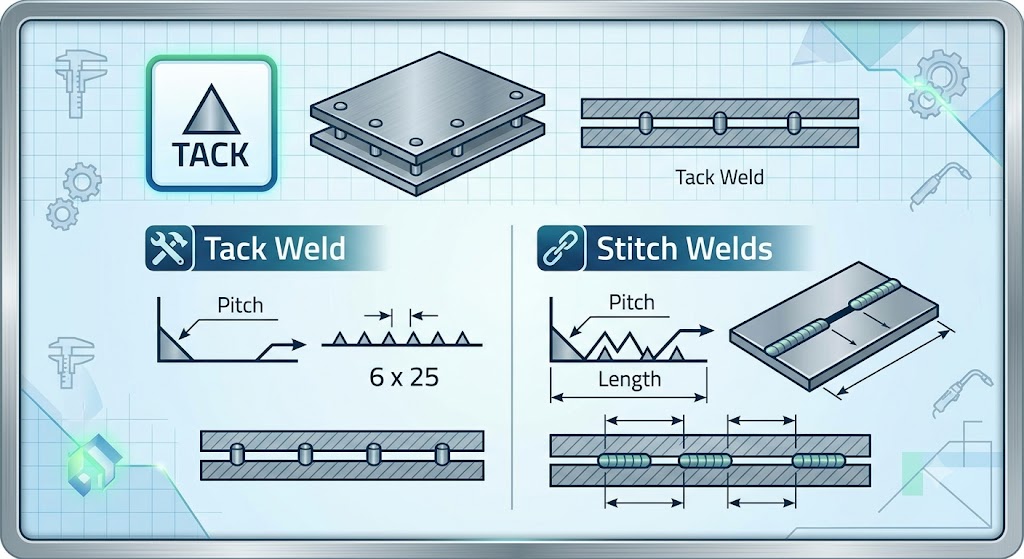
Not every weld runs the full length of a joint. Sometimes you just need a few small welds to hold parts in place before the real welding starts (tack welds), and sometimes the design calls for short welds spaced along a joint instead of one continuous run (stitch, or intermittent, welds). Both are everyday shop practice, and both have their own way of being shown on a drawing. This guide explains tack welds and stitch welds and how to read the length-and-pitch notation that defines them.
A tack weld is a small, temporary weld used to hold parts in alignment before final welding, and it has no unique symbol. A stitch (intermittent) weld is a series of short welds spaced along a joint, shown with a length-pitch notation on the fillet symbol. Here is how both work.
Tack welds versus stitch welds
Though related, these are two different things:
- Tack weld: a small weld to temporarily hold parts in position for fit-up.
- Stitch (intermittent) weld: a permanent design feature of short welds spaced along a joint.
- Tack welds are usually a fabrication step, not always called out with a symbol.
- Stitch welds are specified precisely with length and spacing on the symbol.
Understanding the difference matters: one is a temporary aid, the other is a designed weld pattern.
Direct answer: how they are shown
Here is how each appears on a drawing:
- Tack welds have no dedicated symbol; when called out, they are often shown as a small fillet with a length, or noted in text.
- Stitch welds use the fillet weld symbol with a length-pitch notation to the right.
- The two numbers read as length of weld, then pitch (center-to-center spacing).
- Chain intermittent welds have symbols aligned across the reference line.
- Staggered intermittent welds have the symbols offset above and below.
The length-pitch pair, such as two numbers separated by a dash, is the signature of an intermittent weld.
Tack welds explained
A tack weld is a small weld made to hold parts in the correct position and alignment until the final welds are made. Think of it as clamping with weld metal: it keeps the assembly from shifting during fit-up and welding. Because tack welds are usually a means to an end rather than a specified structural weld, drawings often do not give them a unique symbol, and welders place them as needed by good practice. When a drawing does want tacks called out, they are commonly indicated as small fillet welds with a short specified length, or simply described in a note. One important practical point: tack welds often become part of the final weld, so they should be made with the same care, since a poor tack can leave a defect in the finished joint. Good tacks are small, sound, and placed where the final weld will consume or blend them.
Stitch (intermittent) welds explained
A stitch weld, more formally an intermittent weld, is a deliberate pattern of short weld segments with gaps between them, run along a joint instead of one continuous weld. Designers use intermittent welds where a continuous weld is not needed for strength, reducing weld metal, heat input, and distortion while still holding the joint adequately. This is a permanent, specified feature of the design, not a temporary step, which is the key difference from a tack weld. Because it is specified, it is drawn precisely with the fillet symbol plus a length-and-pitch notation, so the welder knows exactly how long each segment is and how far apart to space them.
Reading the length and pitch notation
This notation is the heart of a stitch weld symbol, so read it carefully. To the right of the fillet triangle, two numbers appear, usually separated by a dash: the first is the length of each weld segment, and the second is the pitch, the center-to-center distance from the start of one segment to the start of the next. So a notation of, say, length then pitch tells you to make welds of that length, spaced that far apart center to center, along the joint. The leg size, as always, sits to the left of the triangle. Two arrangements exist: in a chain intermittent weld, the segments on both sides of the joint line up directly across from each other, and the symbols are drawn aligned; in a staggered intermittent weld, the segments alternate down the joint, and the symbols are drawn offset above and below the reference line to show that stagger. Reading whether the symbols are aligned or offset tells you which pattern to make.
The bottom line
Tack welds and stitch welds are both about welds that do not run continuously, but they serve different purposes. A tack weld is a small, temporary weld to hold parts in alignment for fit-up, has no unique symbol, and is often placed by good practice or noted as a short fillet, and it should be made with care because it can become part of the final weld. A stitch, or intermittent, weld is a designed pattern of short segments with gaps, specified on the fillet symbol with a length-and-pitch notation: length of each segment first, then center-to-center pitch. Aligned symbols mean a chain pattern and offset symbols mean a staggered pattern. Read those two numbers and the symbol arrangement, and intermittent welds are straightforward.
FAQ
What is a tack weld? A tack weld is a small weld used to hold parts in the correct position and alignment until the final welds are made, essentially clamping with weld metal during fit-up. It is usually a fabrication step rather than a specified structural weld, so drawings often do not give it a unique symbol.
Does a tack weld have its own symbol? No dedicated symbol. When a drawing calls out tacks, they are commonly shown as small fillet welds with a short specified length, or simply described in a note. Often welders place tacks as needed by good practice rather than from a specific symbol on the drawing.
What is a stitch or intermittent weld? A stitch weld, formally an intermittent weld, is a deliberate pattern of short weld segments with gaps between them along a joint, instead of one continuous weld. It reduces weld metal, heat input, and distortion where a continuous weld is not needed, and it is a permanent, specified design feature.
How do you read the length and pitch on a stitch weld? To the right of the fillet triangle, two numbers (usually separated by a dash) give the length of each weld segment first, then the pitch, the center-to-center distance from one segment to the next. The leg size sits to the left of the triangle as usual. So you make welds of that length, spaced that pitch apart.
What is the difference between chain and staggered intermittent welds? In a chain intermittent weld, the segments on both sides of the joint line up directly across from each other, and the symbols are drawn aligned. In a staggered intermittent weld, the segments alternate down the joint, and the symbols are drawn offset above and below the reference line to show the stagger.
Do tack welds become part of the final weld? Often yes, which is why they should be made with care. A poor tack can leave a defect in the finished joint if it is consumed or blended into the final weld. Good tacks are small, sound, and placed where the final weld will absorb them, so they do not compromise the completed joint.
References
- AWS A2.4, Standard Symbols for Welding, Brazing, and Nondestructive Examination, intermittent fillet weld provisions (industry standard), aws.org.
- AWS A3.0 terms and definitions for tack welds and intermittent welds (industry standard), aws.org.
- Miller Electric and Lincoln Electric guides to intermittent and tack weld symbols and practice (manufacturers), millerwelds.com, lincolnelectric.com.